THE LATIN MASS SOCIETY IN WREXHAM
  • Home
  • News Blog
  • About the Traditional Mass
    • Responsa Ad Dubia on certain provisions of the Apostolic Letter Traditionis Custodes issued “Motu Proprio”
    • Traditionis Custodes
    • The letter of Pope Francis accompanying Traditionis Custodes
    • CDF 2020 Decree on Saints and Prefaces
    • Universae Ecclesiae
    • Pope Benedict XVI's Letter to the Bishops
    • Summorum Pontificum
    • Holy Days of Obligation >
      • Exchange of Letters
      • LMS Press Release on Holy Days
      • Restoration of Holydays [2017]
    • Apostolic Letter, Sacrificium Laudis
    • Tips on attending the Extraordinary Form
    • Expressions of the Extraordinary Form
    • A quick guide to Mass classification
    • Latin Pronunciation
  • Wrexham Diocese
    • The Cathedral Church
    • About St Richard Gwyn
    • About St Winefride
    • Diocesan Feasts in the 1962 calendar
    • Gweddi dros Gymru
    • Gweddi ar Ddewi Sant
  • LMS Shop
  • Links

First Saturday at Buckley

31/1/2016

0 Comments

 
Picture
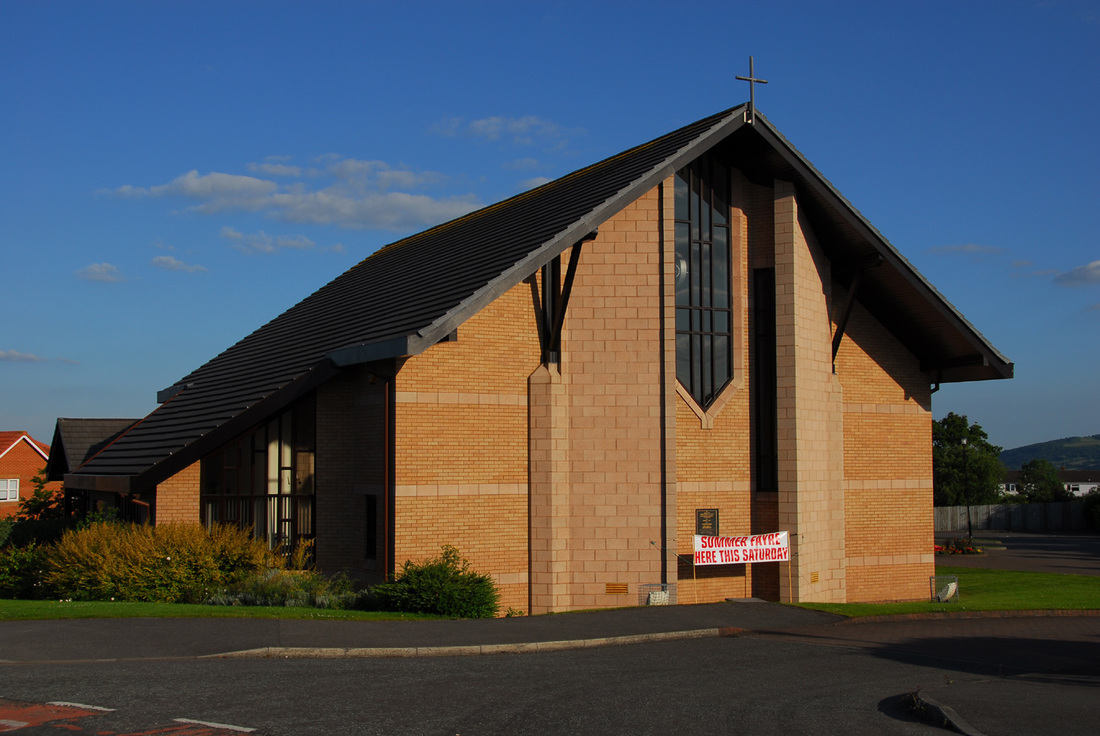
Our Lady of the Rosary, Buckley, Flintshire
Mass in the Extraordinary Form of the Roman Rite

will be celebrated on

Saturday 6th February 2016

at

1230pm

at

Our Lady of the Rosary,
Jubilee Road, Buckley,
Flintshire CH7 2BF
0 Comments

Meditation for the Sunday of Sexagesima

30/1/2016

0 Comments

 
Picture
PRESENCE OF GOD - O, Lord, I am here before You. Grant that my heart may be the good ground, ready to receive Your divine word.
 
MEDITATION
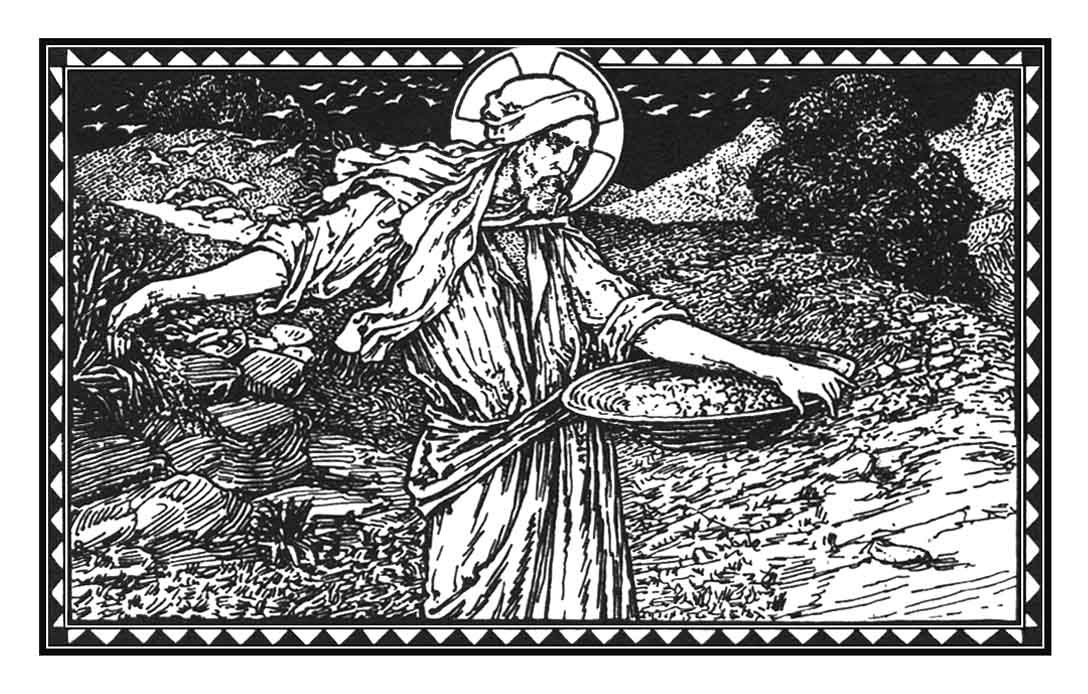
Today Jesus, the divine Sower, comes to scatter the good seed in His vineyard the Church. He wishes to prepare our souls for a new blossoming of grace and virtue. "The seed is the word of God". Jesus Christ, the Word Incarnate, eternal Utterance of the Father, came to sow this word in the hearts of men; it is, as it were, a reflection of Himself. The divine word is not a sound which strikes the air and disappears rapidly like the word of men; it is a supernatural light which reveals the true value of things; it is grace, the source of power and strength to help us live according to the light of God. Thus it is a seed of supernatural life, of sanctity, of eternal life. This seed is never sterile in itself; it always has a vital, powerful strength, capable of producing not only some fruits of Christian life, but abundant fruits of sanctity. This seed is not entrusted to an inexperienced husbandman who, because of his ignorance, might ruin the finest sowing. It is Jesus Himself, the Son of God, who is the Sower.

Then why does the seed not always bring forth the desired fruit? Because very often the ground which receives it does not have the requisitive qualities. God never stops sowing the seed in the hearts of men; He invites them, He calls them continually by His light and His appeals; He never ceases giving His grace by means of the Sacraments; but all this is in vain and fruitless unless man offers God a good ground, that is, a heart, well prepared and disposed. God wills our salvation and sanctification, but He never forces us; He respects our liberty.
 
Today's Gospel (Lk 8, 4-15) mentions four categories of people who receive the seed of the divine word in different ways. It compares them to the hard ground, to the stony soil, the earth choked with thorns, and lastly, to the good fertile field.
 
The hard ground: souls that are frivolous, dissipated, open to all distractions, rumors, and curiosity; admitting all kinds of creatures and earthly affections. The word of God hardly reaches their heart when the enemy, having free access, carries it off, thus preventing it from taking root.
 
The stony ground: superficial souls with only a shallow layer of good earth, which will be rapidly blown away, along with the good seed, by winds of passion. These souls easily grow enthusiastic, but do not persevere and "in time of temptation fall away". They are unstable, because they have not the courage to embrace renunciation and to make the sacrifices which are necessary if one wishes to remain faithful to the word of God and to put it into practice in all circumstances. Their fervor is a straw fire which dies down and goes out in the face of the slightest difficulty.
 
The ground covered with thorns: souls that are preoccupied with the wordly things, pleasures, material interests and affairs. The seed takes root, but the thorns soon choke it by depriving it of air and light. Excessive solicitude for temporal things eventually stifles the rights of the spirit.
 
Lastly, the good ground is compared by Jesus to those "who, with a good and upright heart, hearing the word, keep it, and bring forth fruit in patience." The good and upright heart is the one which always gives first place to God, which seeks before everything else the Kingdom of God and His justice. The seed of the divine word will bear abundant fruit in proportion to the good dispositions it finds in us: recollection, a serious and profound interior life, detachment, sincere seeking for the things of God above and beyond all earthly things, and finally, perseverance, without which the word of God cannot bear its fruit in us.
 
COLLOQUY
O, Jesus, divine Sower, rightly do You complain of the arid, sterile ground of my poor heart! What an abundant sowing of holy inspirations, interior lights, and grace You have cast into my heart! How many times You have invited me to come to You by special appeals, and how many times I stopped, after following You for a short time! O Lord, if only I could understand the fundamental reason for my spiritual sterility, my instability and inconstancy in good! Will Your light fail me? No, for you are continually instructing and admonishing my soul in a thousand ways. Oh! If so many souls living in error and not knowing You have received but a hundredth part of the light which You have given me so profusely, how much fruit would they not have drawn from it!

Will Your grace fail me? Is not Your grace my strength? O Lord, I see that neither Your light nor Your strength will fail me; what I lack is the perseverance which can faithfully withstand temptations, difficulties, and darkness; which can face courageously the sacrifice and austerity of the Christian life. It is easy to make sacrifices and to renounce oneself for a day, but it is hard to keep on doing it always, every day of our life. It is not the reason that You said, O Lord, that the good heart brings forth fruit "in patience"?

O Jesus, who endured with invincible patience Your most sorrowful Passion and death, give me the patience I need to keep up the struggle against my passions and my self-love, patience to embrace with perseverance all the sacrifices required by total detachment, to be able to live without personal satisfactions and pleasures, to do everything that is repugnant to me, that hurts me, that crosses me and is displeasing to my self-love.

O, Lord, You know that I desire total purification because I long for union with You; but You cannot purify me entirely if I cannot accept patiently Your work: the trials, humiliations and detachments that You prepare for me. O Jesus, divine Sufferer, give me Your patience; make me, like Yourself, humble and patient.
 
Credit, meditation for Sexagesima Sunday, "Divine Seed" comes from the book "Divine Intimacy" by Fr. Gabriel of St. Mary Magdalen, OCD.

0 Comments

Holy See: Final approval of Institute Constitution

30/1/2016

0 Comments

 
Important news from the Institute of Christ the King Sovereign Priest (source www.icrsp.org)
Picture
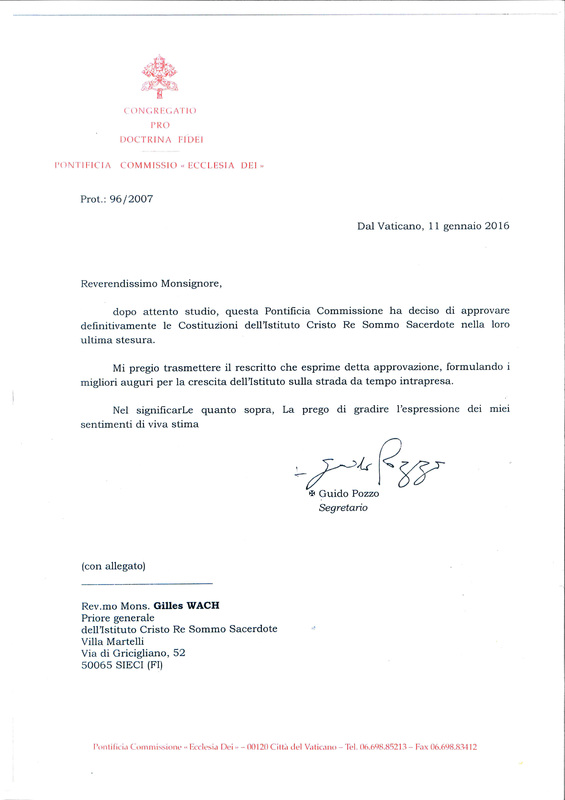
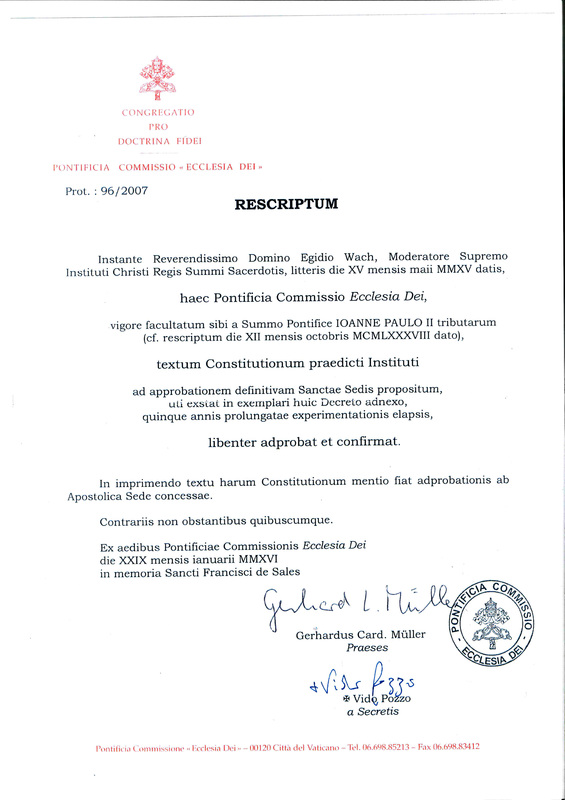
"Le 7 octobre 2008, le décret Saeculorum Rex  érigeait l'Institut du Christ Roi Souverain Prêtre comme société de vie apostolique en forme canoniale de Droit Pontifical. Le 29 janvier 2016, en la fête de saint François de Sales, patron de l'Institut, le Saint-Siège a définitivement approuvé les Constitutions de notre Institut. 

Un Te Deum d'action de grâces a été chanté à Gricigliano à l'occasion des deuxièmes Vêpres de la fête de notre saint patron, et S.Exc.R. Mgr Bacqué, Nonce Apostolique, qui fut Visiteur Apostolique de l'Institut, viendra le 2 février chanter une Messe Pontificale d'action de grâces au séminaire de Gricigliano."

"On the 7th October 2008, the decree Saeculorum Rex erected the Institute of Christ the King Sovereign Priest as a society of apostolic life in the canonical form of Pontifical Right. On the 29th January 2016, the feast of St. Francis de Sales, patron of the Institute, the Holy See definitively approved the Constitutions of our Institute.

A Te Deum of thanksgiving was sung at Gricigliano (the Institute's International Seminary) on the occasion of the second Vespers of the feast of our patron saint, and S.Exc.R. Bacqué Bishop, Apostolic Nuncio, who was the Apostolic Visitor to the Institute, will sing a Pontifical Mass of thanksgiving at Gricigliano on the 2nd February."

Above: Facsimiles of the documents sent by the Holy See (CDF)
0 Comments

Final Call for Lourdes Pilgrimage

26/1/2016

0 Comments

 
Those intending to take part in the ICKSP pilgrimage to Lourdes must make their intentions known to Canon Montjean by Friday.
Picture
0 Comments

Burying the Alleluia

24/1/2016

0 Comments

 
Last evening at First Vespers of Septuagesima, the Alleluia was said for the last time in the Extraordinary Form liturgy until the Easter Vigil of Holy Saturday.

A double "Alleluia”, added at the end of the “Benedicámus Domino” and again after the response “Deo grátias” and that is that until the great night of the vigil.

Over at New Liturgical Movement, there is an interesting article that details how the Fraternity of St Joseph the Guardian in La Londe-les-Maures, France actually bury the Alleluia.

Of course, the changes brought in with the Novus Ordo buried the season of Septuagesima.

For those not familiar with the Old Rite or are not old enough to remember the lovely pre-Lenten season of Septuagesima, I would recommend that you watch this short video made by the LMS and which gives some insight into this not so lost season.
0 Comments

Septuagesima Sunday

23/1/2016

0 Comments

 
Picture
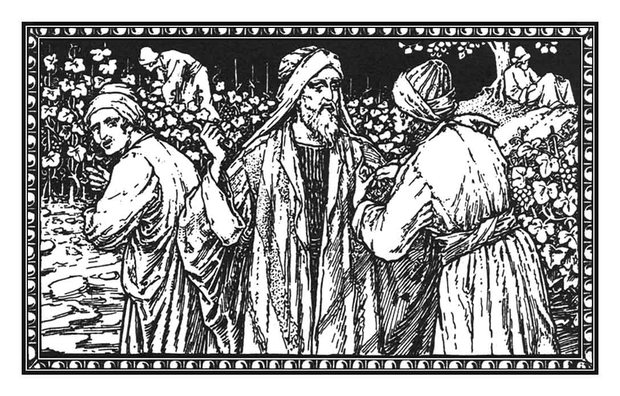
The labourers in the vineyard
Septuagesima Sunday begins the period in the Church’s liturgy in which there is the transition time between the joys of Christmas and Epiphany and the rigours of Lent. Pope St. Gregory the Great established these Sundays before Easter: Septuagesima (70 days), Sexagesima (60 days) and Quinquagesima (50 days) in order to prepare the faithful, both in body and spirit, for the Lenten period of penance. “The Church through the appropriate liturgical texts, tries to make the Christian realize the misery of their state as sinners and their own weakness, in order to prepare them for the need of penance and unite them to the one sacrifice of Christ, which is commemorated in the Lenten cycle.” The period of Septuagesima has been compared to the seventy years of Babylonian captivity where the Jews wept for their sins and longed to return to Jerusalem. So, too, the Church calls us to weep for our sins and long for the joys of the resurrection and of heaven. We see how this is true in today’s Epistle (I Cor. 9:24-27; 10:1-5) where St. Paul reminds the Corinthians to deprive themselves like good athletes in order to prepare for the struggle for the crown of eternal salvation: “...but I chastise my body and bring it into subjection, lest perhaps after preaching to others I myself should be rejected.” I Cor. 9:27 In the Gospel (Mt. 20:1-16) parable of “The Labourers in the Vineyard,” Jesus shows us how important it is to labour in His vineyard, that is, the temporal world, for the reward of the kingdom of heaven. All are invited to work in the vineyard: “Why do you stand here all the day idle?” Mt. 20:6 All are invited to work for their eternal salvation, and no one should be idle and careless in doing the things which will bring this great reward.

“Do you not know that those who run in a race, all indeed run, but one receives the prize? So run to obtain it.” [Epistle I Cor. 9 24]

St. Paul uses the analogy of the runner to show how one must train vigorously to win the prize of a heavenly crown. According to St. Thomas Aquinas, the Christian runs a spiritual race that demands great effort: “Even in the spiritual race, one only receives the prize—he who perseveres to the end. Run, then, for victory; (this) indicates first the effort, then the purpose, lastly the prize.” Like all good athletes, St. Paul demands that the faithful who are aiming at the goal of eternal life should do penance and chastise their bodies lest they lose the eternal crown: “...but I chastise my body and bring it into subjection, lest perhaps after preaching to others I myself should be rejected.” I Cor. 9:27 St. Paul reminds his followers that it is not enough to belong to the chosen race. He reminds them that the Jews were brought out of Egypt and received great graces from God, but some sinned and died in the desert: “Yet with most of them God was not well-pleased, for ‘they were laid low in the desert.’” I Cor. 10:5 The lesson from St. Paul is self-evident: “The Christian is an athlete; and it is not enough for him to cry Lord, Lord, from the gallery. He must be in the arena fight for his life!”

“Even so the last shall be first, and the first last; for many are called, but few are chosen.” [Gospel Mt. 20:16]

These mysterious words of Our Lord become clear when one considers the spiritual meaning of this parable in its allegorical sense. The vineyard is our life in the world where we must strive for the reward of our labours: instead of a denarius for our day’s work, we will gain eternal life. Quoting St. Gregory the Great and St. Augustine, Dom Prosper Gueranger in his book, The Liturgical Life Vol. 4 says that the various hours of the day represent the stages of life: “It signifies the calling given by God to each of us individually, pressing us to labour, during this life, for the kingdom prepared for us. The morning is our childhood. The third hour, according to the division used by the ancients in counting their day at sunrise; it is our youth. The sixth hour, by which name they called our midday, is manhood. The eleventh hour, which immediately preceded sunset, is old age. The Master of the house calls His labourers at all these various hours.” All those called must go at the time when they are summoned as they are not certain that they will be called later. The same happens to us in life: no one is certain that he will live to old age. We need to accept the call to live our faith when we are called. We also need to accept the wage which we are promised. Interestingly, the denarius is a coin comprising ten other coins; so the good Christian must keep the Ten Commandments if he hopes to save his life. Jesus calls all to the kingdom of heaven, but not everyone accepts the invitation. Some who thought that they were special because they came first, may be last; and those who were called last, may be first in the kingdom of heaven.

“Have I not a right to do what I choose? Or art thou envious because I am generous?” [Gospel Mt. 20:15]

When the first labourers came for their wages, they reasoned that they should have a higher wage since they had worked all day. In reality, they were envious of the good fortune of those who worked only part of the day. It seems to be another example of the typical reaction of the Pharisees at Jesus’ generosity to sinners and other non-Jews. Fr. Boylan in “The Sunday Epistles and Gospels,” explains it thus: “The Pharisees were like the early hired workers; they had professed to walk in the ways of the Lord, and for their ‘works of the Law’, they thought themselves fully entitled to demand payment, as wages earned, from God. Against all this outlook the parable is a protest. The Kingdom of Heaven has been offered to all—but in the goodness and mercy of God, and not as a wage definitely earned by work done. Those who might have expected to enter it first of all are likely to be the last to do so, and those whom the Pharisees despised—the ‘people of the land’ and sinners—are among the first to enter the Kingdom.” The Pharisees are the people to whom Jesus often refers in the scriptures who want special favours for being His followers yet they lack His spirit: “’We ate and drank in thy presence, and thou didst teach in our streets.’ And he shall say to you, ‘I do not know where you are from. Depart from me all you workers of iniquity.” Lk. 13: 26-7 Let us be thankful for having been called to be a follower of Christ, and let us wish that all our fellow men would also accept Jesus’ call even if it is at “the eleventh hour”.

The Capital Sin of Envy
Envy implies sorrow at the happiness and prosperity of our neighbour. For which reason the envious man is never without sadness or trouble. Are his neighbour’s fields green and fertile? Is his house a happy one? Is he not lacking interior and spiritual happiness? All these signs of prosperity increase the illness and disturb the mind of the envious man. St. Basil tells of the evil effects of envy: “The envious man is hurt by the good fortune of a friend; the joy of his brothers causes him pain; he cannot look with favour on the riches of another and considers the prosperity of his neighbour as a misfortune for himself. If he wished to tell the truth, he would be forced to confess this; but since he does not wish to make it manifest, he keeps this hatred in his heart, where it gnaws away at his entrails.” St. Basil, “Homily 11 on Envy”
0 Comments

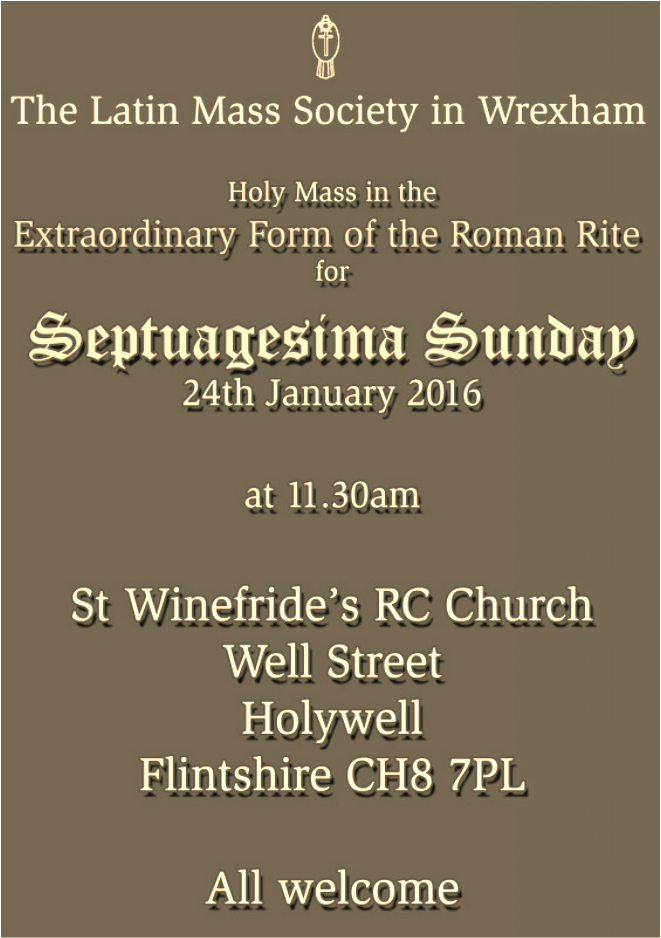
Septuagesima Sunday at Holywell

21/1/2016

0 Comments

 
Picture
0 Comments

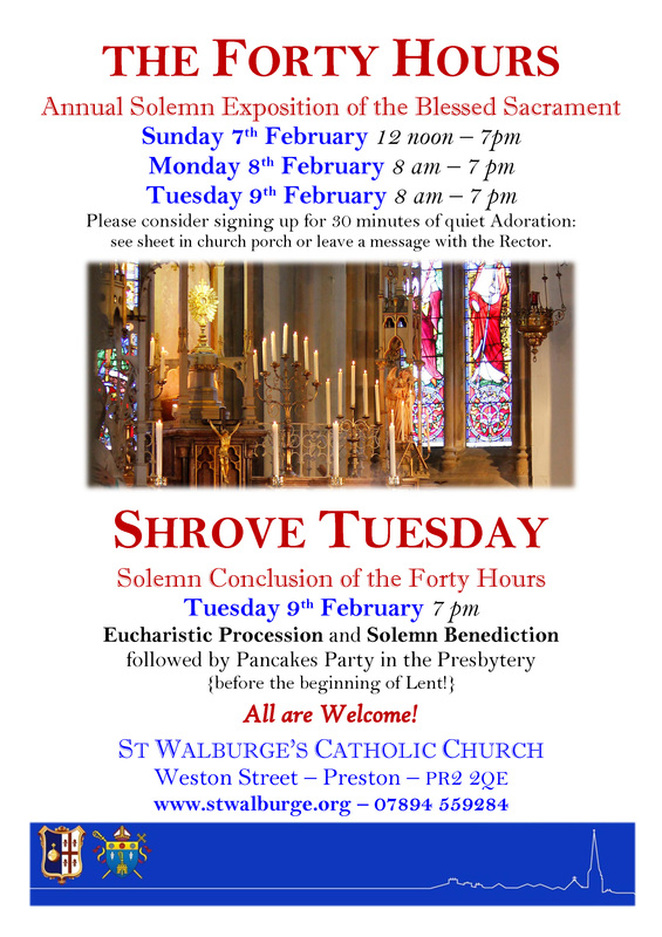
Quarant' Ore at Preston

20/1/2016

0 Comments

 
Picture
0 Comments

Progress on EWTN's mini-series 'The Inquisition'

20/1/2016

0 Comments

 
Picture
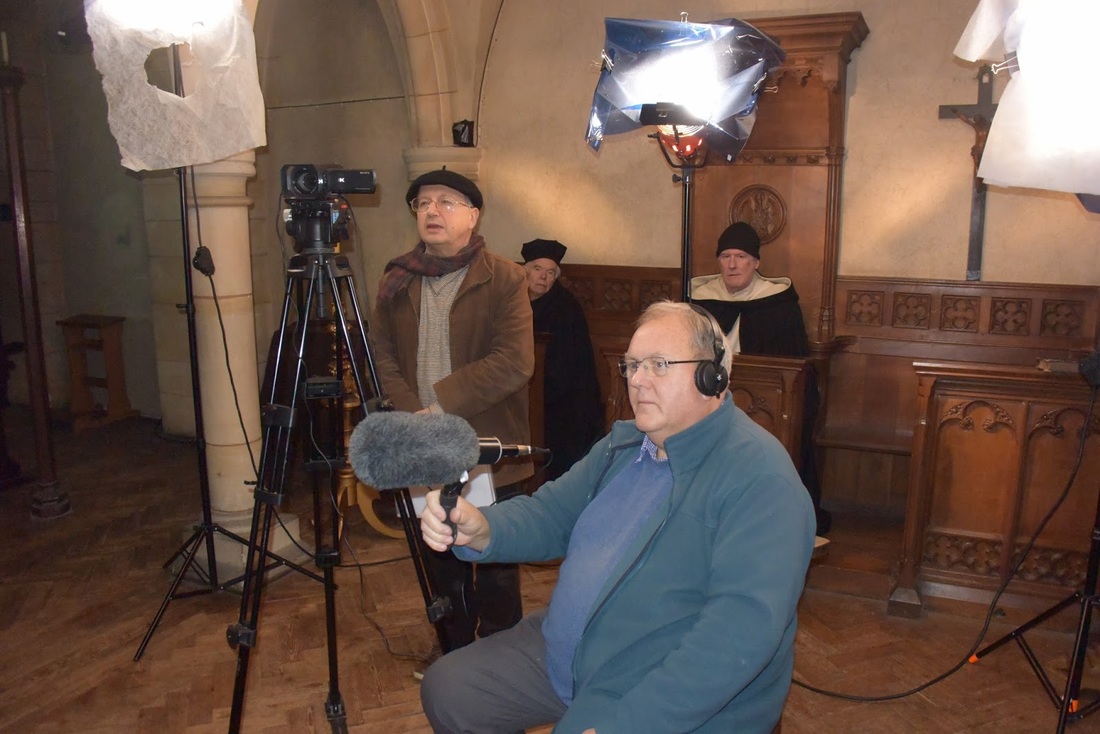
Fellow LMS Committee Member, Stefano Mazzeo is busy working on his latest film for EWTN.

Some commentary and photographs of the final shoot which took last weekend can be viewed here.

In the The Inquisition, Stefano is striving to get to the truth of the matter. Seeing beyond the myth and legend by presenting the events in a factual and unbiased way, especially dispelling much of the false testimony that exists against the Catholic Church.

Watch this space for more progress reports and broadcast dates in due course.
0 Comments

Talk on the Latin Mass at Warrington

17/1/2016

0 Comments

 
Picture
On Wednesday 20th January at 7pm at St Mary’s, Buttermarket Street, Warrington WA1 2NS, Father Armand de Malleray FSSP will give a second talk about the Traditional Mass.

  • Puzzled by the Latin Mass? 
  • Questions & answers for all. 
  • All are welcome, especially if you know nothing or little about the traditional Latin Mass (also called the Extraordinary Form of the Roman Rite). 
  • Father de Malleray will talk on the spirituality of Holy Mass.
  • Free for all. All welcome!

Free parking on church car park: access via SMITH Street, WA1 2NS

0 Comments

Second Sunday after Epiphany

16/1/2016

0 Comments

 
Introit (Psalm 65, 4) for Mass on the Second Sunday after Epiphany
OMNIS TERRA adóret te, Deus, et psallat tibi: psalmum dicat nómini tuo, Altissime. Ps. 65, 1, 2. Jubiláte Deo, omnis terra, psalmum dícite nómini ejus, date glóriam laudi ejus. V. Glória Patri, et Fílio, et Spirítui Sancto. Sicut erat in princípio, et nunc, et semper, et in sæcula sæculórum. Amen.
LET ALL the earth adore Thee, O God, and sing to Thee: let it sing a psalm to Thy name, O Thou most high. Ps. 65, 1, 2. Shout with joy to God all the earth, sing ye a psalm to His name, give glory to His praise. V. Glory be to the Father, and to the Son, and to the Holy Ghost. As it was in the beginning, is now, and ever shall be, world without end. Amen.
Picture
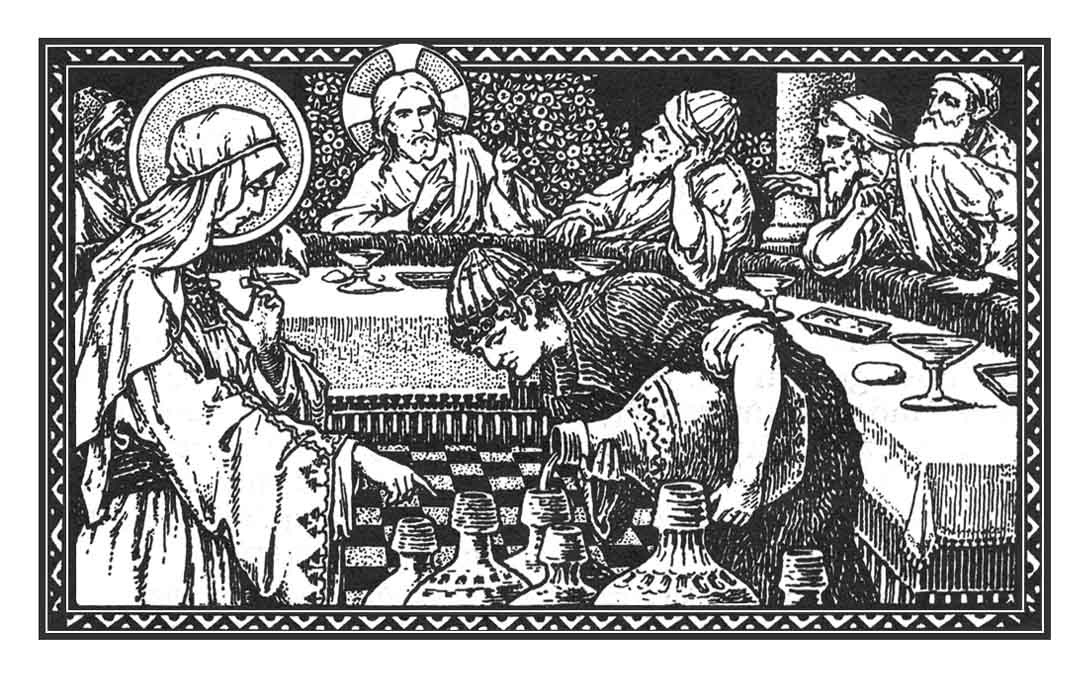
“But thou hast kept the good wine until now.” Jn. 2:9

Dom Prosper Gueranger in his book, The Liturgical Year Vol 3, tells us of the mystery of today’s feast: “The third Mystery of the Epiphany shows us the completion of the merciful designs of God upon the world, at the same time that it manifests to us for the third time (the first time to the Shepherds and Magi at the stable and the second time to Jewish people at the Baptism of St. John the Baptist), the glory of our Lord and Saviour, Jesus Christ. The star has led the soul to faith, the sanctified Waters of the Jordan have conferred purity upon her; the Marriage-Feast unites her to her God. We have been considering, during this Octave, the Bridegroom revealing himself to the Spouse; we have heard him calling her to come to him from the heights of Libanus; and now, after having enlightened and purified her, he invites her to the heavenly feast, where she is to receive the Wine of his divine love.

The New Wine of Charity
“A Feast is prepared (cf. Jn. 2): it is a Marriage-Feast; and the Mother of Jesus is present at it, for it is just that, having co-operated in the mystery of the Incarnation of the Word, she should take part in all that her Son does, and in all the favours he bestows on his elect. But, in the midst of the feast, the Wine fails. Wine is the symbol of Charity or Love, and Charity had failed on the earth; for the Gentiles had never tasted its sweetness; and as to the Synagogue, what had it produced but wild grapes (cf. Is. 5:2). The True Vine is our Jesus and he calls himself by that name (Jn. 15:1). He alone could give that Wine which gladdeneth the heart of man (cf. Ps. 53:15). He alone could give us that Chalice which inebriated (cf. Ps. 22:5), and of which the Royal Psalmist prophesied.

“Do whatsoever he shall say to you.” Jn. 2:5
“Mary said to Jesus: They have no Wine. It is the office of the Mother of God to tell him of the wants of men, for she is also their Mother. But Jesus answers her in words which are apparently harsh: Woman! What is it to me and to thee? My hour is not yet come.’ The meaning of these words is, that, in this great Mystery, he was about to act, not as the Son of Mary, but as the Son of God. Later on, the hour will come when, dying upon the Cross, he will do a work, in the presence of his Mother, and he will do it as Man, that, according to that human nature which he has received from her. Mary at once understands the words of her Son, and she says to the waiters of the Feast, what she is now ever saying to her children: ‘Do whatsoever he shall say to you.’

The New Wine of Christ
“Now, there were six large waterpots of stone there, and they were empty. The world was then in its Sixth Age, as St. Augustine and other Holy Doctors tell us. During these six ages, the earth had been awaiting its Saviour, who was to instruct and redeem it. Jesus commands these waterpots to be filled with water; and yet water does not suit the Feast of the Spouse. The figures and the prophecies of the ancient world were this water, and until the opening of the Seventh Age, when Christ, who is the Vine, was to be given to the world, no man had contracted an alliance with the Divine Word.

“But, when the Emmanuel came, he had but to say, Now draw out, and the waterspots were seen to be filled with the wine of the New covenant, the Wine which had been kept to the end. When he assumed our human nature—a nature weak and unstable as water—he effected a change in it; he raised it up even to himself, by making us partakers of the divine nature (cf. 2 Pet. 1:4); he gave us the power to love him, to be united to him, to form that one Body of which he is the Head, that Church of which he is the Spouse and which he loved from all eternity, and with such tender love, that he came down from heaven to celebrate his nuptials with her.

Jesus Manifests His Glory as God
“St. Matthew, the Evangelist of the Humanity of our Lord, has received from the Holy Ghost the commission to announce to us the Mystery of Faith by the star; St. Luke the Evangelist of Jesus’ Priesthood, has been selected by the same Holy Spirit, to instruct us in the mystery of the Baptism in the Jordan; but the Mystery of the Marriage-Feast was to be revealed to us by the Evangelist John, the Beloved Disciple. He suggests to the Church the object of this third Mystery, by this expression, ‘This beginning of miracles did Jesus in Cana of Galilee, and he MANIFESTED his glory.’ Jn. 2:11 At Bethlehem, the God of the Magi expressed the Divinity of the Babe; at the Jordan, the descent of the Holy Ghost and the voice of the Eternal Father proclaimed Jesus (known to the people as a carpenter of Nazareth) to be the Son of God; at Cana, it is Jesus himself that acts, and he acts as God, for, says St. Augustine, he who changed the water into wine in the waterpots could be no other than the same who, every year, works the same miracle in the vine. Hence it was that, from that day, as St. John tells us, ‘his disciples believed in him’ (cf. Jn. 2:), and the Apostolic College began to be formed.” Gueranger, p. 241-3

The “good wine” of Christ and His Bride, the Church
The Lord delights in performing this miracle. God has saved the “good wine” for last: “But thou hast kept the good wine until now.” Jn. 2:9 The new wine of Jesus is charity. St. Paul shows us the superabundant gifts of the Spirit which come in the New Testament with the charismatic gifts and the practice of fraternal charity. It is the new wine with the blessing of the Church on Holy Matrimony in which the love which husband and wife have for each other is similar to the love that Christ has for His Church: “Husbands, love your wives, just as Christ also loved the Church, and delivered himself up for her, that he might sanctify her, cleansing her in the bath of water (Baptism) by means of the word; in order that he might present to himself the Church in all her glory, not having spot or wrinkle or any such thing, but that she might be holy and without blemish.” Eph. 5:25-7 St. Paul also speaks of this love which we need to have for one another in today’s Epistle to the Romans (12: 6-16): “Let love be without pretense. Hate what is evil, hold to what is good. Love one another with fraternal charity, anticipating one another with honour. Be patient in tribulation, persevering in prayer, Share the needs of the saints, practising hospitality. Bless those who persecute you; bless and do not curse. Rejoice with those who rejoice; weep with those who weep. Be of one mind toward one another….” Rom 12: 9-16

Divine Charity, Our Espousal with Christ
Dom Gueranger comments on the spiritual meaning of today’s Gospel (Jn. 2: 1-11) of Jesus’ miracle of changing water into wine: “Thus divine Charity, which dwells in the Sacrament of Love (Holy Eucharist), is communicated to us; and that we might not be unworthy of the espousals with himself, to which he called us, he raises us up even to himself. Let us therefore, prepare our souls for this wonderful union, and, according to the advice of the Apostle, let us labour to present them to our Jesus with such purity as to resemble that chaste Virgin, who was presented to the spotless Lamb (cf. 2 Cor. 11:2 and Eph. 5: 27). Gueranger, p. 247. Jesus not only manifests Himself with the miracle of changing water into wine at Cana, but He shows how we are called to be His spouse in the Heavenly Marriage Feast.
0 Comments

ICKSP Pilgrimage to Lourdes [updated]

15/1/2016

0 Comments

 
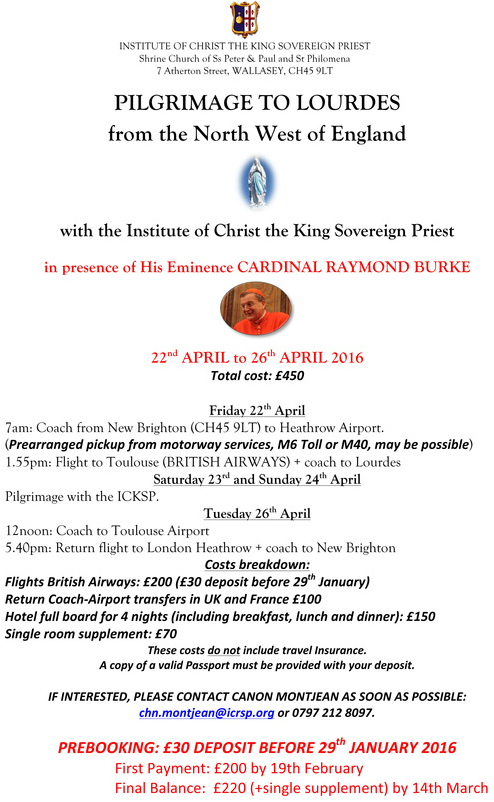
Want to join the Institute of Christ the King Sovereign Priest on their 2016 pilgrimage to Lourdes?

PILGRIMAGE TO LOURDES from the North West of England with the Institute of Christ the King Sovereign Priest in presence of His Eminence CARDINAL RAYMOND BURKE
22nd APRIL to 26th APRIL 2016
Total cost: £450
Friday 22h April: 7am: Coach from New Brighton (CH45 9LT) to Heathrow Airport.
(Prearranged pickup from motorway services, M6 Toll or M40, may be possible) 
 
1.55pm: Flight to Toulouse (BRITISH AIRWAYS) + coach to Lourdes
Saturday 23rd and Sunday 24th April: Pilgrimage with the ICKSP.
Tuesday 26th April: 12noon: Coach to Toulouse Airport
5.40pm: Return flight to London Heathrow + coach to New Brighton
Costs breakdown:
Flights British Airways: £200 (£30 deposit before 29th January)
Return Coach-Airport transfers in UK and France £100
Hotel full board for 4 nights (including breakfast, lunch and dinner): £150 Single room supplement: £70
These costs do not include travel Insurance.
A copy of a valid Passport must be provided with your deposit.
IF INTERESTED, PLEASE CONTACT CANON MONTJEAN AS SOON AS POSSIBLE: [email protected] or 0797 212 8097.
PREBOOKING: £30 DEPOSIT BEFORE 29th JANUARY 2016
First Payment: £200 by 19th February
Final Balance: £220 (+single supplement) by 14th March 


Contact Canon Montjean at Ss Peter & Paul and St Philomena as soon as possible -accommodation and travel needs to be arranged soon! For more information, click here.
0 Comments

Bishop Athanasius Schneider to visit all three North West centres for the Traditional Mass in February

15/1/2016

0 Comments

 
Picture
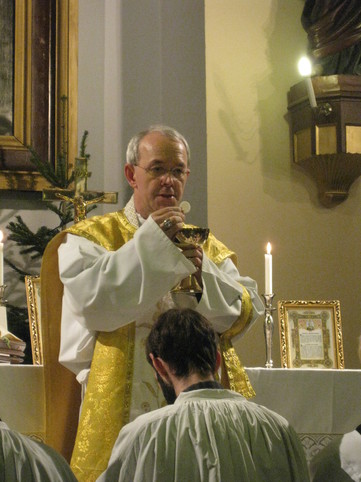
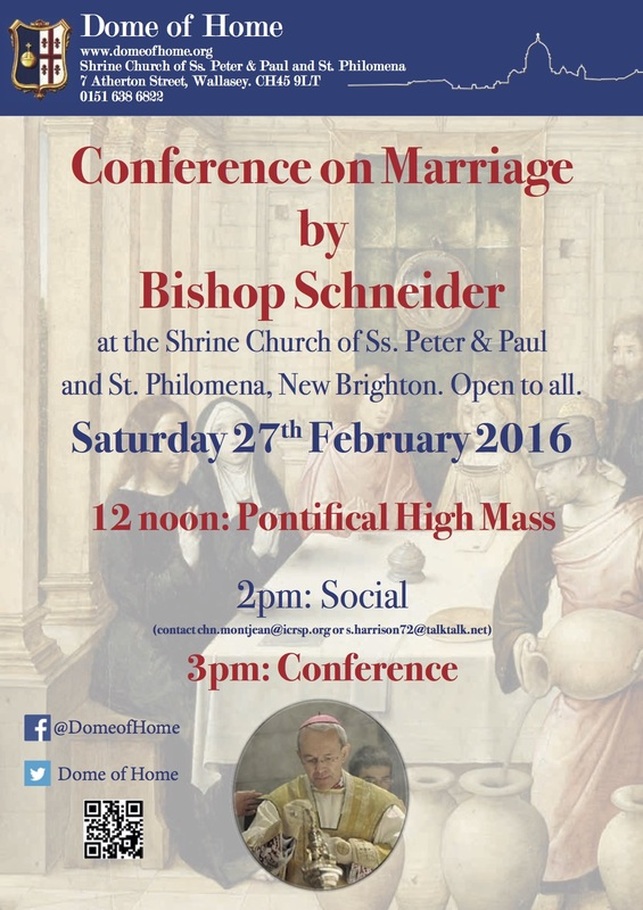
Bishop Athanasius Schneider O.R.C. will visit all three North Western centres for the Traditional Mass next month.

The itinerary for the visit is:
  • Friday 26th February - He will visit St Walburge's, Preston.
  • Saturday 27th February - He will visit Ss Peter & Paul and St Philomena, New Brighton (see below)
  • Sunday 28th February - He will celebrate Pontifical Low Mass with music at 11am and then after refreshments at 12.15pm, give a spiritual talk at 1pm at St Mary's in Warrington, the new home of the FSSP.
Picture
Bishop Schneider was born in Tokmok, Kirghiz SSR in the Soviet Union. His parents were ethnic Germans from Ukraine who were sent by Stalin to gulags in the Ural Mountains after the Second World War. They traveled to the Kirghiz SSR after being released from the camps.

In 1973, shortly after making his first Holy Communion by the hand of Bl. Oleksa Zaryckyj, priest and martyr, he left with his family for Germany. He joined the Canons Regular of the Holy Cross of Coimbra, a Catholic religious order, and was ordained a priest in 1990, earning a doctorate in Patristics, a topic he taught at Mary Mother of the Church Seminary in Karaganda.

On 2 June 2006 he was consecrated Bishop at the Altar of the Chair of Saint Peter in the Vatican by Angelo Cardinal Sodano. In 2011 he was made auxiliary bishop in the Archdiocese of Astana.

He has written two short books, Dominus Est (It is the Lord) and Corpus Christi.
0 Comments

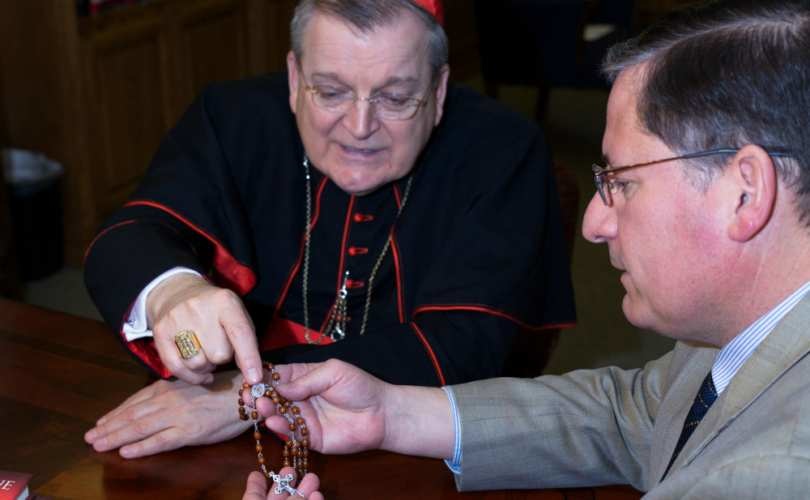
Cardinal Burke is looking for 1 MILLION Catholics who will pray the Rosary on the first of every month. 

14/1/2016

0 Comments

 
Picture
I received an e-mail from LifeSiteNews yesterday which I reproduce below with hope it may generate some interest from readers of this blog:

"Cardinal Raymond Burke is urging faithful Catholics to “storm heaven” by joining with him once a month in the Mass and the Rosary to pray for hope and guidance out of the current “confusion” in the Church and the world!

Ultimately, the Cardinal is hoping that 1 million Catholics like you will join the campaign! That may be an ambitious goal. But the current crisis in the Church and our culture demands dramatic action. 

The lay Catholic organization Catholic Action for Faith and Family has put up a page on its website for “Rosary Warriors” to sign on to the joint effort, which Cardinal Burke launched with a Mass in Rome on December 8.

Click here or below to sign on to join Cardinal Burke's Operation "Storm Heaven"!
 
Each Mass and Rosary will be offered to obtain from God, through the intercession of the Blessed Virgin Mary, the following graces and for the following intentions:

  • For Holy Mother Church: that Our Lord guide the Pope, the bishops and all members of the clergy to be holy in all things, faithful shepherds, beacons of Truth, and defenders of Good;
  • That all confusion be dispelled from the hearts and minds of all people and may the Light of Truth shine in them;
  • For our families and the family institution that is being so attacked in our world;
  • For the conversion of all sinners to the True Faith
  • To obtain the graces necessary to stop abortion, stop the onslaught of the homosexual revolution, to overturn legalized same-sex marriage, to stop the spread of physician-assisted suicide and euthanasia, and to stop the culture of death in all its forms and establish the Culture of Life in all souls, in all minds and in all hearts;

Each month, participants in the campaign will also be able to send their own personal intentions. These intentions will be placed on the altar in Rome during the Mass celebrated by Cardinal Burke and included in his Rosary. Your intentions will also be included in every Rosary recited by our Rosary Warriors.


0 Comments

Salutary Lesson?

14/1/2016

0 Comments

 
Picture
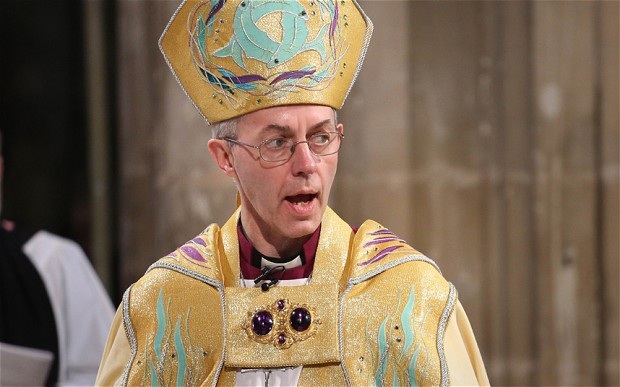
Problems for Welby right now - will his summit prevent split?
Over at Rorate Caeli, there is a post about Sandro Magister's recent column in which he claims that the Holy Father is open to creating "exceptions" in the matter of priestly celibacy in the Latin Rite. He goes onto explain that it is German and German-Brazilian clerics who are driving this agenda.

The same post goes on to talk of potential admittance to "celibate" homosexual priests, which not surprisingly the German liberals see as being quite integral to the relaxation current laws regarding priestly celibacy. 

All very messy.

Clearly, in many places there are individuals, both cleric and lay who advocate this sort of abandonment of Tradition, Scripture, and Magisterium in favour of a populist Church and in doing so going against every grain of truth for which it was established in the first place.

Pray to God, that in this Year of Mercy, [which may yet become a means to deliver some of this relaxation], those who foster and promote such views and agenda see the extreme error of their ways.

Now, take a look at what is going on in Canterbury. Similar issues but not helped by a decentralised network of Protestant 'components', which appear to be heading toward division.

As if Rome needed any better a prophetic sign.
0 Comments
<<Previous
    Pope Francis
    Picture
    Oremus pro Pontifice nostro Francisco: Dominus conservet eum, et vivificet eum, et beatum faciat eum in terra, et non tradat eum in animam inimicorum eius.


    Picture
    Picture
    Omnipotens sempiterne Deus, qui facis mirabilia magna solus: praetende super famulos tuos, et super congregationes illis commissas, spiritum gratiae salutaris; et, ut in veritate tibi complaceant, perpetuum eis rorem tuae benedictionis infunde.


    Any views expressed neither represent those of the Latin Mass Society or the Diocese of Wrexham.

    Archives

    August 2022
    July 2022
    June 2022
    May 2022
    April 2022
    March 2022
    February 2022
    January 2022
    December 2021
    November 2021
    October 2021
    September 2021
    August 2021
    July 2021
    June 2021
    May 2021
    April 2021
    March 2021
    February 2021
    January 2021
    December 2020
    November 2020
    October 2020
    September 2020
    August 2020
    July 2020
    June 2020
    May 2020
    April 2020
    March 2020
    February 2020
    January 2020
    December 2019
    November 2019
    October 2019
    September 2019
    August 2019
    July 2019
    June 2019
    May 2019
    April 2019
    March 2019
    February 2019
    January 2019
    December 2018
    November 2018
    October 2018
    September 2018
    August 2018
    July 2018
    June 2018
    May 2018
    April 2018
    March 2018
    February 2018
    January 2018
    December 2017
    November 2017
    October 2017
    September 2017
    August 2017
    July 2017
    June 2017
    May 2017
    April 2017
    March 2017
    February 2017
    January 2017
    December 2016
    November 2016
    October 2016
    September 2016
    August 2016
    July 2016
    June 2016
    May 2016
    April 2016
    March 2016
    February 2016
    January 2016
    December 2015
    November 2015
    October 2015
    September 2015
    August 2015
    July 2015
    June 2015
    May 2015
    April 2015
    March 2015
    February 2015
    January 2015
    December 2014
    November 2014
    October 2014
    September 2014
    August 2014
    July 2014
    June 2014
    May 2014
    April 2014
    March 2014
    February 2014
    January 2014
    December 2013
    November 2013
    October 2013

    RSS Feed

Powered by Create your own unique website with customizable templates.