THE LATIN MASS SOCIETY IN WREXHAM
  • Home
  • News Blog
  • About the Traditional Mass
    • Responsa Ad Dubia on certain provisions of the Apostolic Letter Traditionis Custodes issued “Motu Proprio”
    • Traditionis Custodes
    • The letter of Pope Francis accompanying Traditionis Custodes
    • CDF 2020 Decree on Saints and Prefaces
    • Universae Ecclesiae
    • Pope Benedict XVI's Letter to the Bishops
    • Summorum Pontificum
    • Holy Days of Obligation >
      • Exchange of Letters
      • LMS Press Release on Holy Days
      • Restoration of Holydays [2017]
    • Apostolic Letter, Sacrificium Laudis
    • Tips on attending the Extraordinary Form
    • Expressions of the Extraordinary Form
    • A quick guide to Mass classification
    • Latin Pronunciation
  • Wrexham Diocese
    • The Cathedral Church
    • About St Richard Gwyn
    • About St Winefride
    • Diocesan Feasts in the 1962 calendar
    • Gweddi dros Gymru
    • Gweddi ar Ddewi Sant
  • LMS Shop
  • Links

Passion Sunday and liturgy of the first week of Passiontide

28/3/2020

0 Comments

 
Picture
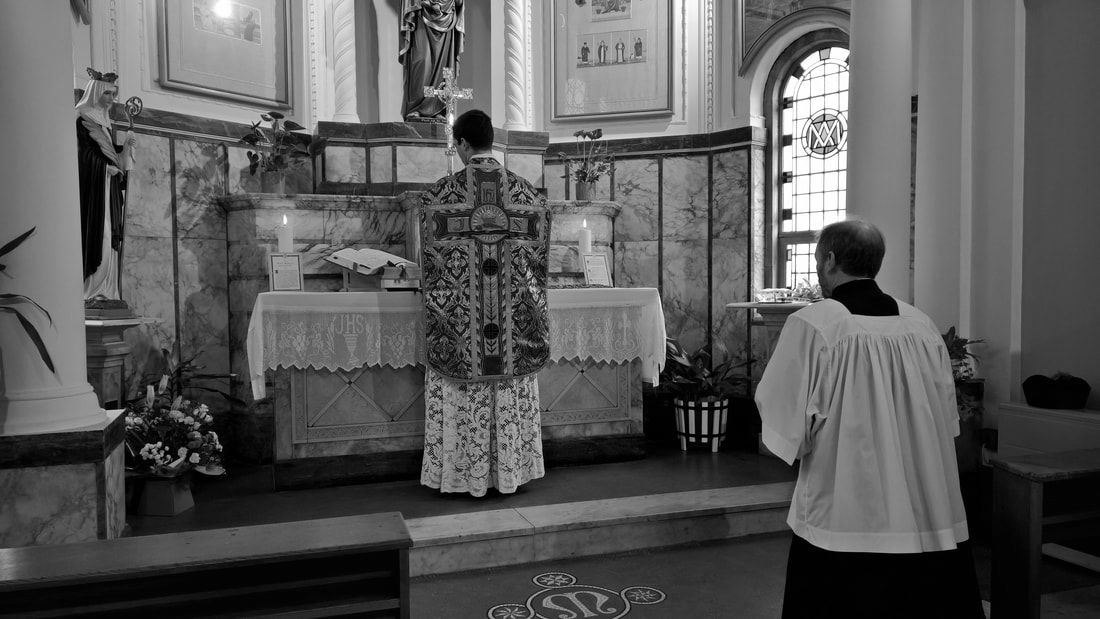
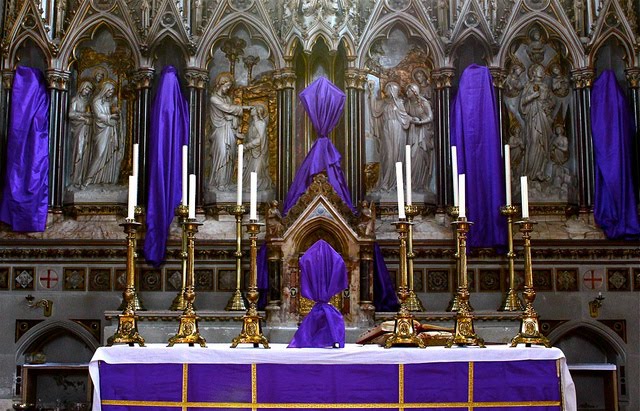
The Crucifix over the main altar is veiled today. Think it over in amazement! Jesus is obliged to hide Himself when “humanity” ‘stones” ‘Divinity” (Gospel). The Jewish synagogue makes its final decision to ignore the miracles, the doctrine and the sinless of Christ, even though all these were prophesied in their own Old Testament. Due to stiff-necked pride and hard-hearted materialism, their part of the covenant had become a dead letter. Jesus makes a terrifying analysis of them: “You are not of God.” In the Epistle St. Paul indicates how the High Priest of the Old Testament offered the blood sacrifices of victim goats, an offering which acknowledged that man deserves to be done away with for trying to do away with God by sinful rebellion. He now beholds the Altar of Calvary where Jesus, Eternal High Priest, sheds His Precious Blood to “cleanse our conscience” and “to serve the Living God.” Let us not “stone” Christ or cause Him to hide Himself. Station today is at St. Peter’s. Statues and Crosses in the churches are veiled, special Preface is said, and in the older rubrics of the Mass, the Collect against the persecutors of the Church or for the Pope is added this week. The hatred of the Jews toward Christ is shown in the weekly Gospels. The Mass of today concerns the Passion of Christ. Introit regards an innocent person being unjustly persecuted. In the Epistle of today’s Mass the redemption is contrasted with the personages of the Old Law. In the Gospel Our Lord proclaims His Divinity.
 
This Week:
 
Monday 30th March
Station at St. Chrysogonus. Penance is emphasised in the Mass as taking the example of Nineveh to illustrate how penance can obtain, even for the Gentiles, God’s Mercy. Might this not be a good day for bishops to declare a day of public penance to stem the tide of the Coronavirus? Mass is of the Monday in Passion Week.
 
Tuesday 31st March
Station is at St. Cyriacus. Mass is of Tuesday in Passion Week. Epistle relates Daniel in the lion’s Den showing God’s Mercy toward His Church. The Gospel shows how the common people loved Our Lord but were frightened by His enemies. Enemies of Our Lord regarded Him in their rhetoric as a seducer, somebody who made promises, to bring over the people from the Temple. As so often happens, the leaders of the state mis-use their authority to promote their own agenda by using calumny as a weapon.
 
Wednesday 1st April
Station is at St. Marcellus. Originally, the church was home to the holy matron, Lucina, which she donated to become a church that was consecrated by Pope St. Marcellus in 306, wherein his body resides. Mass of Wednesday in Passion Week. Catechumens in the Epistle are in-structed as to the Commandments of God which forms the basis for Chris-tians as opposed to the lack of rules for pagans and unbelievers. The Gospel shows how the Jews refused to examine the teachings of Jesus and charged Him with blasphemy. Our Lord denied such charges and asserted His Divine nature.
 
Thursday 2nd April
Today Votive Mass of Our Lord Jesus Christ High and Eternal Priest may be celebrated, where devotions for the sanctification of priests are made, with commemoration of St, Francis of Paula C. of the XVI Century, known for his humility and devotion to the sufferings of Christ. Commemoration of the Thursday in Passion Week is made. Station is at St. Apollinaris honouring St. Apollinaris, Patron of Ravena, Capital of Rome after the fall of Rome to barbarians. In the Epistle Azarius mourns the fate of his nation but has confidence in God’s Mercy to those who seek it. The Gospel relates the forgiveness of Mary Magda-lene.
 
First Friday 3rd April
Today is a special day in that two Masses of the Most Sacred Heart of Je-sus may be celebrated in churches and oratories where Devotions in honour of His Most Sacred heart are made. Two Votive Masses in honour of the Seven Sorrows of the Blessed Virgin Mary may also be celebrated with Gloria, Sequence and Preface of the Blessed Virgin. In both Votive Masses commemoration is made of the Friday in Passion Week. Station is at St. Stephen on the Coellian Hill, the First Martyr, whose relics reside within the church. The Lessons of the Mass tell how Jeremias, a high priest in Jerusalem, was unjustly persecuted by his own people and how the just man turns to God for help and recovery of his reputation. The Gospel shows the intentions of the Jewish leaders to put Our Lord to death.
 
First Saturday 4th April
Votive Mass of the Immaculate Heart of the Blessed Virgin may be celebrated today if Devotions of Reparation are made. Commemoration of St. Isidore E. C. D. of the VII Century, Bishop of Seville, would be made in the Votive Mass as well as commemoration of the Saturday in Passion Week. Duties of a Bishop are laid out clearly in the Mass of the Saint. Station is at St. John the Evangelist Before the Latin Gate, honouring the Saint who was in Rome about 77 A.D. and was saved from death miraculously after being plunged into a vat of boiling oil. In ancient times there was no Mass for this day in order that the catechumens could prepare for ceremonies the next day. The Gospel of the Mass describes Our Lord’s triumphant entry into Jerusalem.
Courtesy of Liturgy and Devotion
0 Comments

Significant decrees from the CDF on new Prefaces and celebration of Saints canonised post 1960

25/3/2020

0 Comments

 
The below decrees have been on the horizon for some considerable time. The conspiracy theorists may make several conclusions about the timing of their release but to be fair, I was expecting them to released last year prior to Advent.

Do not be alarmed. This is not a plot to rip pages out of the good book and paste in modern replacements, Remember: the Missale Romanum remains intact there is nothing taken from it and the additions offered by way of these developments are entirely optional.

Pope Benedict had been clear he desired development of the traditiona liturgy and work has been going on for many years to arrive at these decrees. It is a signal that the Traditional Liturgy is not about to be sidelined and also that Rome's interest has not stagnated.

New Liturgical Movement has a useful analysis here.

Picture
CONGREGATION FOR THE DOCTRINE OF THE FAITH

Note for the presentation of the Decree Cum sanctissima on the liturgical celebration in honour of Saints
in the forma extraordinaria of the Roman Rite
With the Decree Cum sanctissima of 22 February 2020, the Congregation for the Doctrine of the Faith, which since January 2019 deals with those matters formerly assigned to the Pontifical Commission “Ecclesia Dei”[1], completed the work initiated several years earlier by that Commission in order to fulfill the mandate given by Pope Benedict XVI to facilitate the celebration of more recently canonized Saints according to the forma extraordinaria of the Roman Rite [2]. Indeed, since the Sanctoral of the forma extraordinaria is determined by the liturgical books in force in 1962, Saints canonized thereafter were not included therein.

The studies carried out in order to develop a practical solution for the liturgical celebration of more recent Saints in the Usus Antiquior provided an opportunity to address the many issues that this matter raises, such as the density of the existing calendar (particularly as regards III class feasts), the consideration of all the repercussions of any potential changes, the always preferable consistency between Mass and the Divine Office, and the matter of the liturgical texts to be used.

In this context, it appeared that rather than dealing with this or that more recent Saint, it would be more appropriate to lay down a general principle that would enable, within the general rubrical context of the forma extraordinaria, and when the liturgical day permits, the celebration of any Saint canonized after the 1960s, on the date of their proper feast.

Specifically, the Decree broadens the scope of missæ festivæ latiore sensu referred to in n. 302-c of the Rubricæ Generales Missalis Romani (which hitherto only applied to IV class days), to a number of III class feasts and to III class vigils[3] (cf. Decree, n. 1). It is therefore clear that the new provisions will not in any way affect other celebrations, and in particular those of the I or II classes. 

In addition, the Decree specifies that missæ festivæ latiore sensu may be celebrated in honour of Saints canonized after 26 July 1960 (which is the date of the last amendment to the Martyrology of the forma extraordinaria), on their respective liturgical feast day (n. 2).

With this principle in mind, the other provisions of the Decree give the necessary indications that derive therefrom, such as the applicability to the Divine Office, which in such a case is to be celebrated in full in honour of the Saint (n. 3), the requirement to make a commemoration of potentially occurring III class feasts, as the case may be (n. 4), and the rules relating to the selection of the liturgical texts to be used (n. 5). Regarding this particular point, one should note the three successive sources from which texts are to be drawn, namely in the first place the Proprium Sanctorum pro aliquibus locis which already exists in the Missal of the forma extraordinaria, secondly a special Supplement to be published by the Holy See in the future, and finally, should the two former sources be lacking, the existing Commune Sanctorum.

It is noteworthy that the celebration of more recent Saints pursuant to the new provisions is a mere possibility, and therefore it remains optional. Accordingly, those who wish to continue to celebrate the Saints according to the existing calendar of the forma extraordinaria as it appears in the liturgical books, remain free to do so. In relation to this, one should be reminded that the existence of optional feasts in honour of the Saints is not a complete novelty in the Roman Rite, given that throughout the post-tridentine period, and up till the rubrical reform carried out by Pope St. Pius X, the calendar included no less that twenty-five such so-called ad libitum feasts.

The new Decree also opens a further possibility for cases in which whilst following the existing calendar, one wishes at the same time to honour eventual other occurring Saints. Specifically, according to n. 6 of the Decree, an ad libitumcommemoration of an occurring Saint may be made, if said Saint appears in the Proprium pro aliquibus locis or in the future special Supplement.

In choosing whether or not to make use of the provisions of the Decree in liturgical celebrations in honour of the Saints, the celebrant is expected to make use of good pastoral common sense. As regards the particular case of celebrations in Religious Institutes and Societies of Apostolic Life, n. 7 of the Decree provides some useful clarification. 

The Decree concludes (n. 8) with reference to a list of seventy III class feasts that may never be impeded by its provisions. This list, which is provided as an annex, reflects the particular importance of the feasts in question, on the basis of precise criteria, e.g. the importance of these respective Saints in the Plan of Salvation or in the history of the Church, their importance in terms of either the devotion they have generated or their writings, or the antiquity of their worship in Rome.
______________________
[1] Cf. Francis, Apostolic Letter in the form of Motu Proprio on the Pontifical Commission “Ecclesia Dei”, 17 January 2019.
[2] “New Saints (…) can and should be inserted in the old Missal. The “Ecclesia Dei” Commission, in contact with various bodies devoted to the Usus Antiquior, will study the practical possibilities in this regard”: Benedict XVI, Letter to the Bishops on the occasion of the publication of the Apostolic Letter “Motu Proprio Data” Summorum Pontificum on the use of the Roman Liturgy prior to the reform of 1970, AAS 99 (2007) 798. This mandate was further confirmed and completed in 2011 by the Instruction Universæ Ecclesiæ of the same Pontifical Commission: cf. Pontifical Commission “Ecclesia Dei”, Instruction on the Application of the Apostolic Letter Summorum Pontificum of His Holiness Benedict XVI given Motu Proprio, n. 25, AAS 103 (2011) 418.
[3] In fact there is only one such III class vigil in the calendar of the forma extraordinaria, namely that of St. Lawrence on 9 August. On this subject one may be reminded that from 1568 until the Codex Rubricarum of 1960, non-privileged vigils such as that of St. Lawrence were of the simplex rite, and accordingly, when they fell in occurrence with a semiduplex or duplex feast of a Saint, that feast would prevail over the vigil. With the reform enacted under St. Pius X in 1911-1914, in non-conventual Masses the celebrant could, in certain cases, choose between the Mass of the occurring Saint or the Mass of the vigil (cr. Additiones et variationes in rubricis Missalis, n. 1).

The Decree concludes with reference to a list of seventy 3rd class feasts that may never be impeded:

Ianuarius
17 S. Antonii Abb.
20 Ss. Fabiani Papae et Sebastiani Mm.
21 S. Agnetis Virg. et Mart.
24 S. Timothei Ep. et Mart.
25 In Conversione S. Pauli Ap.
26 S. Polycarpi Ep. et Mart.
27 S. Ioannis Chrysostomi Ep., Conf. et Eccl. Doct.
29 S. Francisci Salesii Ep., Conf. et Eccl. Doct.
31 S. Ioannis Bosco Conf.


Februarius
01 S. lgnatii Ep. et Mart.
05 S. Agathae Virg.et Mart.
06 S. Titi Ep. et Conf.


Martius
06 Ss. Perpetuae e Felicitatis Mm.
07 S. Thomae de Aquino Conf. et Eccl. Doct.
09 S. Franciscae Romanae, Vid.
12 S. Gregorii I Papae, Conf. et Eccl. Doct.
21 S. Benedicti Abb.
24 S. Gabrielis Archang.


Aprilis
11 S. Leonis I Papae, Conf. et Eccl. Doct.
14 S. Iustini Mart.
30 S. Catharinae Senensis Virg.


Maius
02 S. Athanasii, Ep., Conf. et Eccl. Doct.
04 S. Monicae Vid.
05 S. Pii V Papae et Conf.
09 S. Gregorii Nazianzeni Ep., Conf. et Eccl. Doct.
25 S. Gregorii VII Papae et Conf.
26 S. Philippi Nerii Conf.


Iunius
05 Bonifatii Ep. et Mart.
11 S. Barnabae Ap.
13 S. Antonii de Padua Conf. et Eccl. Doct.
14 S. Basilii Magni Ep., Conf. et Eccl. Doct.
21 S. Aloisii Gonzagae Conf.
30 In Commemoratione S. Pauli Ap.


Iulius
07 Ss. Cyrilli et Methodii Epp. et Cc.
14 S. Bonaventurae Ep., Conf. et Eccl. Doct.
19 S. Vincentii a Paulo Conf.
22 S. Mariae Magdalenae Paenitentis
29 S. Marthae Virg.
31 S. lgnatii Conf.


Augustus
02 S. Alfonsi Mariae de Ligorio Ep., Conf. et Eccl. Doct.
04 S. Dominici Conf.
05 In Dedicatione S. Mariae ad Nives
08 S. Ioannis Mariae Vianney Conf.
12 S. Clarae Virg.
20 S. Bernardi Abbatis et Eccl. Doct.
28 S. Augustini Ep., Conf. et Eccl. Doct.
29 In Decollatione S. Ioannis Bapt.


September
03 S. Pii X Papae et Conf.
12 Sanctissimi Nominis B. Mariae Virg.
16 Ss. Comelii et Cypriani Ep., Mm.
27 Ss. Cosmae e Damiani Mm.
30 S. Hieronymi Presb., Conf. et Eccl. Doct.


October
02 Ss. Angelorum Custodum
03 S. Teresiae a Iesu Infante Virg.
04 S. Francisci Conf.
06 S. Brunonis Conf.
14 S. Callisti I Papae et Mart.
15 S. Teresiae Virg.


November
04 S. Caroli Ep. et Conf.
11 S. Martini Ep. et Conf.
14 S. Iosaphat Ep. et Mart.
18 In Dedicatione Basilicarum Ss. Petri et Pauli App.
22 S. Caeciliae Virg. et Mart.
23 S. Clementis I Papae et Mart.
24 S. Ioannis a Cruce Conf. et Eccl. Doct.


December
03 S. Francisci Xaverii Conf.
06 S. Nicolai Ep. et Conf.
07 S. Ambrosii Ep., Conf. et Eccl. Doct.
11 S. Damasi I Papae et Conf.
13 S. Luciae Virg. et Mart.


Picture
CONGREGATION FOR THE DOCTRINE OF THE FAITH
Note for the presentation of the Decree Quo magis approving seven Eucharistic Prefaces for the forma extraordinaria of the Roman Rite
With the Decree Quo magis of 22 February 2020, the Congregation for the Doctrine of the Faith, which since January 2019 deals with those matters formerly assigned to the Pontifical Commission “Ecclesia Dei”[1], has approved the text of seven new Eucharistic Prefaces to be used ad libitum in the celebration of Mass according to the forma extraordinaria of the Roman Rite[2].

This Decree constitutes the completion of the work previously initiated by the aforementioned Pontifical Commission in order to carry out the mandate given by Pope Benedict XVI to add some additional Prefaces to the Missal of the forma extraordinaria[3].

The studies carried out lead to the selection of a limited number of texts, to be used for particular occasions such as feasts of Saints, votive Masses or ad hoc celebrations, without making any changes to the celebration of the temporal cycle. This choice was made in order to safeguard, through the unity of texts, the unanimity of sentiments and of prayer that are appropriate for the confession of the mysteries of Salvation celebrated in what constitutes the backbone of the liturgical year. In addition, the historical development of the Corpus Præfationum of the Missale Romanum up until the middle of the 20th Century shows a general movement towards the use of new prefaces for occasional celebrations rather than for celebrations of the temporal cycle.

At the same time, the opportunity was taken to extend to all those who celebrate in the Usus Antiquior the faculty to use three other Prefaces previously approved for certain places. These too are texts for determined occasional celebrations.

Four of the newly approved texts, namely the Prefaces de Angelis, de Sancto Ioanne Baptista, de Martyribus and de Nuptiis, are taken from the Missal of the forma ordinaria, and for the most part their central section, known as the “embolism”, appear in ancient liturgical sources. In order to guarantee consistency with the rest of the Corpus Præfationum of the old Missal, in three cases, the standard forms of Preface conclusion of the forma extraordinaria have been used. As indicated, the three other texts (Prefaces de Omnibus Sanctis et Sanctis Patronis, de Sanctissimo Sacramento and de Dedicatione ecclesiæ) are Prefaces previously granted to French and Belgian Dioceses, where they were in use before the post-conciliar liturgical reform. From now on, these may be used wherever Mass is celebrated in the forma extraordinaria.

Two of the seven Prefaces will allow to aptly give more prominence to liturgical celebrations in honour of certain leading figures in God’s design, as manifested in the history of Salvation, namely the Angels and St. John the Baptist, which hitherto both lacked a proper Eucharistic Preface in the Usus Antiquior. In the same vein, the Preface de Martyribus will allow to further underline the eminent character of the gift of martyrdom among the other witnesses of Sequela Christi. Indeed, the first Saints recognized as such were the Martyrs. The Prefaces de Dedicatione Ecclesiæ, de Omnibus Sanctis et Sanctis Patronis and de Ss.mo Sacramento, already in use in some places, will appropriately enrich the celebrations in question with a more suitable eucology than the standard Præfatio Communis. Finally, special note should be taken of the Preface de Nuptiis, which together with the long Nuptial Blessing still in use in Masses pro Sponsis, is to be found – with minor variations – in early Sacramentaries such as the Gelasianum Vetus or the Gregorianum. This ancient Preface, already existing in the forma ordinaria, may therefore now be used in the forma extraordinaria as well.

As indicated above, the use or not, in the relevant circumstances, of the newly approved Prefaces remains an ad libitum choice. Obviously, the celebrant is expected to make use of good pastoral common sense in this regard. In addition, it should be noted that the Decree does not cancel any eventual concessions of proper Prefaces granted in the past, and therefore in those particular cases where there already exists, on the basis of preceding permissions, and for the same liturgical circumstance, a different particular Preface, one may choose between that Preface and the newly approved text.
______________________
[1] Cf. Francis, Apostolic Letter in the form of Motu Proprio on the Pontifical Commission “Ecclesia Dei”, 17 January 2019.
[2] The texts of these Prefaces, with the musical notation according to the various tones in use in the forma extraordinaria, will be available at the Libreria Editrice Vaticana.
[3] “Some of the new Prefaces can and should be inserted in the old Missal. The “Ecclesia Dei” Commission, in contact with various bodies devoted to the Usus Antiquior, will study the practical possibilities in this regard”: Benedict XVI, Letter to the Bishops on the occasion of the publication of the Apostolic Letter “Motu Proprio Data” Summorum Pontificum on the use of the Roman Liturgy prior to the reform of 1970, AAS 99 (2007) 798. This mandate was further confirmed and completed in 2011 by the Instruction Universæ Ecclesiæ of the same Pontifical Commission: cf. Pontifical Commission “Ecclesia Dei”, Instruction on the Application of the Apostolic Letter Summorum Pontificum of His Holiness Benedict XVI given Motu Proprio, n. 25, AAS 103 (2011) 418.
0 Comments

Laetare Sunday - the IV of Lent

21/3/2020

0 Comments

 
Picture
We have passed the half-way mark in our Lenten season of penance. Our Holy Mother the Church reminds us that even in the midst of penance we are to have a cheerful heart. This seems even more fitting as this will be the first Sunday without Mass due to the current pandemic situation. The violet color is set aside and rose is used in its place today.

The joy and celebration of today are not a ceasing of our penances and mortifications, but are rather a reminder to find peace and happiness even in the midst of suffering. As we bear the burden of our crosses, our human nature groans under the weight and is often tempted not only to sadness, but to even melancholy and despair. Today is a gentle reminder, not to let this happen, but to look forward to the rewards that await us if we successfully perform our Lenten duties.

We are not children of the slave girl, but through our baptism we are children of the free woman. We have been made free in Jesus Christ. We are not slaves, but rather children of God. The child and the slave both serve, but the child serves the father, out of love, rather than out of fear. All too often, we obey God with a servile (servant) fear, rather than with a filial (son) fear. Our Lenten works need to be focused upon serving God or making an offering to God, as do His faithful children. We should avoid serving God as servants out of fear. The servant also tries to do as little as possible, or just enough to get by. The son, however, strives to go above and beyond in his service to his father, because he is motivated by love. This is what we have been called to do. The Israelites of the Old Testament served God as servants/slaves. Catholics of the New Testament are children of God, and should serve Him with love and reverence.

In today's Gospel, we see that the people followed Jesus out into the desert, to hear the Words of God. Separated from the material things and any care or solicitude for material things, the people were free to hear Jesus speak, and fill their hearts and minds with His grace. We, also, have begun a spiritual journey this Lent. We have spiritually separated ourselves from the material things, or at least from the care and solicitude for material things. It is sometimes a very painful separation, but it is a necessary separation if we are to be found worthy of receiving the Word of God. As long as our hearts and minds are filled with the cares of the body, we have no room for God and His Word.

Care and solicitude for the things of this earth become habitual with us, and it is never easy to break habits. God is calling us during this Lenten season to step away from these for a short while. He is showing us the good things that await us if we will only make the sacrifice. Too often, we form the desire for the wonderful things that God holds out for us, but the habit of clinging to the things of this earth pulls us back. The Catholic Church, in Her, loving mercy, gives us a foretaste today of the joys that awaits us, so that we may be strengthened with a renewed resolve to faithfully follow Christ to the end of this penitential season — and to the end of our lives here on earth.

We need not fear anything. God will provide for us. In the Gospel today, we see that Jesus not only fed the people with His teachings, but He also fed their bodies. He provided, not just enough, but a superabundant amount of food. All those who followed Him and left everything behind, were not found to be wanting in anything. They were filled with nourishing food provided by God; but more importantly, their souls were nourished with the Word of God.

In the Church, we do not see the multiplication of food for the body, but rather we see the multiplication of the Heavenly Food for our Souls. Jesus Christ becomes our food. He multiplies Himself, so that we need not go away without Him. In the Holy Eucharist, He is really and truly present — True God and True Man — the Living God. In this manner, we may approach Him, and find all the nourishment that we need for both body and soul. We know that we must fast and abstain in preparation for receiving Him, but this mortification is not seen as a pain or a burden, but is welcomed with joy. Or rather, like the multitude in today's Gospel, we do not even think of or consider the wants or needs of the body, as we focus all our attention upon the glories of God.;

Keep safe! Keep praying!

0 Comments

Spiritual Nourishment in these dark days

18/3/2020

0 Comments

 
Picture
The Canon's of the Institute of Christ the King Sovereign Priest will commence live streaming various liturgical events including the Holy Sacrifce of the Mass during this suspension period.

Details of these arrangements can be found here.

If you are restricted in movement due to quarantine or sickness, why not say the Breviary? An online version can be found here and it is formatted in such away that marker ribbons are not involved! The Divine Office of the church is a most beautiful way to offer up prayer and be united in doing so with the Holy Mother Church as she sanctifies the day.

Finally, some words I read from the US at the weekend and wholly applicable here now as well:

"The precept of attending Mass on Sundays and holy days of obligation is a ―positive law imposed by the authority of the Church in order to assure that we fulfil our duty to give God the worship He is due and so that we may be sanctified by attendance at the holy sacrifice. This is a precept which gravely binds in conscience, i.e., missing Mass on such days without a valid reason is a mortal sin. As a law imposed by the authority of the Church, this precept can also be dispensed by the competent Church authorities for a sufficient reason. For those who judge it necessary to use this dispensation, please be reminded that the Third Commandment itself is a divine law, and that even when legitimately dispensed from the ecclesiastical precept, the duty to sanctify Sunday remains according to one’s ability (extra prayers, Rosary, spiritual communion, reading the missal, etc.)."
0 Comments

Convid 19 - All Public Masses Suspended

18/3/2020

0 Comments

 
Picture
The President and Vice-President of the Bishops' Conference of England and Wales have issued a letter informing priests and the faithful that from this Friday, 20th March 2020, all public celebrations of Mass are suspended. Read the text of the letter HERE.

0 Comments

Third Sunday of Lent

14/3/2020

0 Comments

 
Picture
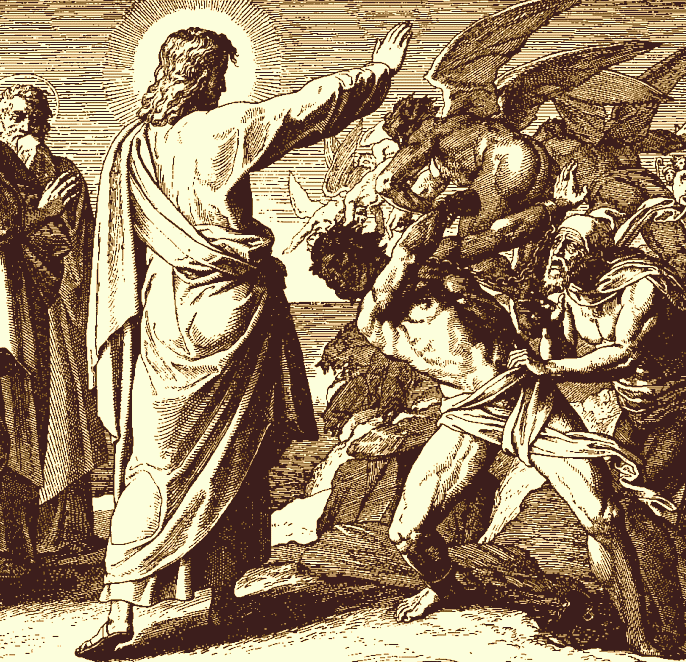
In this Sunday's Gospel we see our Lord casting out a demon. And our Lord tells us what happens to the soul when the demon has been cast out. The devil returns and brings seven others worse than himself to enter that soul once again.

The devils do not always manifest themselves by taking possession of a body, in this manner. They much prefer to be unknown and unseen. Very likely most of the people that we know or see are under the influence of one or more demons. Heretics and apostates often become blind to the truth due to the influence of demons.

If we wish to avoid a like misfortune, we must not allow ourselves to waste the graces and opportunities that God has given us. This season of Lent our Holy Mother the Church wishes us to examine our conscience so that we can make a good confession. The principal requisite for a good confession is contrition.

True contrition is supernatural. Contrition is supernatural, when we are sorry for our sins, not on account of their natural evil consequences, but from a supernatural motive, because thereby we have offended God and deserved hell. If one were sorry for one's sins only from a natural motive, say, on account of the temporal loss, or from shame, or because sin is base and degrading, and unworthy of a rational being, this would be only a natural sorrow. Such a sorrow is good in itself, but it is not sufficient to obtain the forgiveness of sins. The reason is because those who have only a natural contrition, do not hate and detest the sin as such, but only the temporal evils of sin; they are not sorry for having offended God, but only for the temporal evils which they have brought on themselves by sin; and as their heart is not yet averted from the evil God cannot forgive them. Alas! There are many sinners who have only natural contrition.

As for everything salutary for the welfare of the soul, so for true supernatural contrition, we need the grace of God, but because God wishes to be asked for His graces, at least for those subsequent graces by means of which we are saved, we must pray to Him to give us the grace of true contrition. The Saints did so. Saint Charles Borromeo every year entered into a spiritual retreat of at least eight days, in order to prepare himself for his annual confession. On the day on which he made it, he spent several hours on his knees, in order to ask God for the grace of true contrition, and yet St. Charles had scarcely a venial sin to confess. It is therefore desirable, not only to invoke the Holy Ghost at the beginning, but also after the examination of conscience, to pray God to give us the grace of true contrition.

God is the King of heaven and earth. A subject who rebels against his king deserves death; what does the sinner deserve who raises the standard of rebellion against his God and with barefaced impudence says to him: "I will not serve Thee." God is goodness itself towards us and showers upon us numberless benefits; is it not the basest ingratitude towards Him to return evil for His goodness and benefits? What a horrible crime the Jews committed when they crucified Jesus? What does the sinner do? He renews the crime of the Jews as often as he commits a mortal sin, for he that sins crucifies Jesus anew.

Consider how severely God punished the rebellious angels whom He cast out of heaven into the abyss of hell; Adam and Eve, who with their posterity, He chastised with his indignation and tribulations of every sort; the people in the days of Noah, whom he drowned in the deluge; the inhabitants of Sodom and Gomorrah, whom He destroyed by fire and brimstone. Let us consider what we lose by sin. We lose by every mortal sin sanctifying grace that grace purchased for us by the blood of Jesus; we lose all our previous merits as well as the supreme prerogative, obtained by our baptism, of being children of God and heirs, with His own divine Son, to the kingdom of heaven. What a loss! Lastly, let us consider what awaits the sinner. Hell. Hell with all its pains that will never end. Oh, who would not, considering all this, hate and detest sin above all things!

Let us do all we can to obtain by the grace of God true supernatural contrition. Without contrition confession is useless, worse than useless. Without contrition, true and supernatural, no sinner can be saved. All of them that have ever been, saved, have been saved by contrition, while, on the other hand, every soul in hell today is there for want of contrition. Let us then follow in the footsteps of the true penitents, excite ourselves in every confession — nay, daily, to a hearty sorrow for our sins, that God may pardon us here and give us penitents a place in His kingdom hereafter. Amen.

0 Comments

PRAYER IN TIMES OF EPIDEMIC

13/3/2020

0 Comments

 
An extract from the Rituale Romanum, Titulus IX, Caput X
V Dómine, non secúndum peccáta nostra fácias nobis.
R Neque secúndum iniquitátes nostras
retríbuas nobis.
V Adjuva nos, Deus, salutáris noster.
R  Et  propter  glóriam  nóminis  tui, Dómine, líbera nos
V Dómine, ne memineris iniquitátum nostrárum antiquárum.
R Cito  antícipent  nos  misericórdiæ tuæ, quia páuperes facti sumus nimis.
V Ora pro nobis, sancte Sebastiáne.
R Ut digni efficiámur promissiónibus Christi.
V Dómine, exáudi oratiónem meam.
R Et clamor meus ad te véniat.
V Dóminus vobíscum.
R Et cum spíritu tuo.

Orémus.

Exáudi nos, Deus salutáris noster: et intercedénte beáta et gloriósa Dei genitríce María semper vírgine, et beáto Sebastiáno mártyre tuo, et ómnibus Sanctis, pópulum tuum ab iracúndiæ tuæ terróribus líbera, et misericórdiæ tuæ fac largitáte secúrum.

Propitiáre, Domine, supplicatiónibus nostris: et animárum et córporum medére languóribus: ut remissióne percépta, in tua semper benedictióne lætémur.

Da nobis, quǽsumus, Dómine, piæ petitiónis efféctum: et pestiléntiam mortalitatémque propitiátus avérte; ut mortálium corda cognóscant, et te indignánte tália flagélla prodíre, et te miseránte cessáre. Per Dóminum.

R Amen.

Ultimo benedicit cum Reliquia S. Crucis, dicens:
Benedíctio Dei omnipoténtis, Patris, et Fílii, + et Spíritus Sancti, descéndat super vos, et máneat semper.
R Amen.
V Deal not with us, Lord, according to our
sins.
R And take not vengeance on us because of our misdeeds.
V Help us, O God, our Deliverer.
R And for thy name's sake, O Lord, free us.
V Remember not, O Lord, our sins of old.
R Hasten to us with thy compassion, for we are become exceeding poor.
V St. Sebastian, pray for us.
R That we may be made worthy of the promises of Christ.
V O Lord, hear my prayer.
R And let my cry come unto thee.
V The Lord be with you.
R And with thy spirit

Let us pray.

Vouchsafe to hear us, O God, our only salvation! And through the intercession of the glo- rious and blessed Mary, Mother of God and ever Virgin, of thy blessed martyr, Sebastian and of all the saints, deliver thy people from the terrors of thy wrath, and restore their confidence by the outpouring of thy compassion.

Be moved to pity, O Lord, at our earnest entreaties, and heal the illnesses of body and soul; so that experiencing thy forgiveness we may ever rejoice in thy blessing.

We beseech thee, O Lord, grant us a hearing as we devoutly raise our petitions to thee, and graciously turn away the epidemic of plague which afflicts us; so that mortal hearts may recognise that these scourges proceed from thine indignation and cease only when thou art moved to mercy. Through our Lord…

R Amen
The priest then blesses the people with a relic of the True Cross, saying:
And may the blessing of Almighty God, Father, Son and Holy Spirit descend upon you and remain forever.
R Amen
0 Comments

Next Mass at Llay

8/3/2020

0 Comments

 
An early update for those who were not at Llay today.

Canon's treatment becomes more aggressive imminently (please continue with your prayers). Therefore, he does not feel able to celebrate the Passion Sunday Mass which itself had been planned to replace Easter Sunday.

The next Mass at Llay therefore is planned for Sunday 10th May at 1230pm; however I do recommend a check back at this site for further announcements.
0 Comments

Second Sunday of Lent

7/3/2020

0 Comments

 
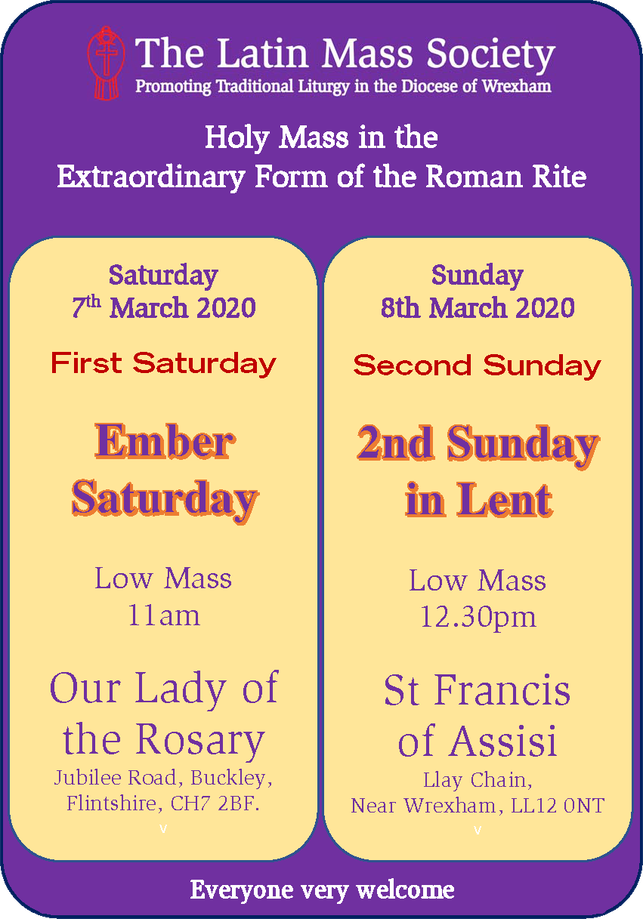
Mass for the 2nd Sunday of Lent will be celebrated at St Francis of Assisi Church at Llay, near Wrexham
tomorrow at 1230pm

Picture
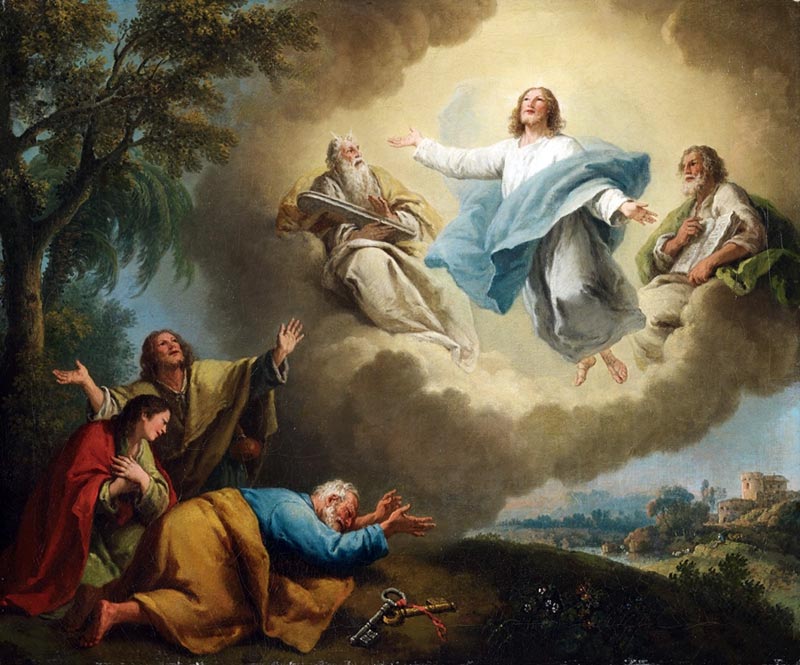
In today's Gospel, we find Our Lord on Mount Tabor transfigured before three of His Apostles, and in the presence of Moses and Elias. Jesus had previously spoken to the Apostles of His coming crucifixion and death. So that they would not be without consolation, Jesus has revealed His true nature to them. With clear eyes these three Apostles saw Jesus as both God and Man in this glorified state. Moses and Elias were there to confirm that Jesus is the One that they were awaiting and preparing the way for. And less there should be any further doubt, the Father spoke from the heavens and indicated that Jesus is His Son in Whom He is well pleased; and that we should hear Him.

Many commentators point out to us that this miracle of the Transfiguration was less a miracle, than the miracle of Jesus hiding His divinity all during His sojourn here upon earth. The Transfiguration allowed the Apostles to see Jesus as He truly is — in His Divine glory. It was a lifetime miracle that God performed in keeping Jesus' Divinity hidden from the eyes of men. He lived in the presence of men, but most of them were never given the grace to see that He is God.

God is truly present among us at all times and in all places. Tragically, however, we seldom see Him. If we would only open our eyes with faith we could see Him. He is right in front of us, but we don't see Him. How truly blind we have become! The glory of God is manifest right before our eyes in all the good things He has given us. If we had the faith of St. Francis of Assisi we could see God and rejoice in all of His creations. The earth, the sky, the trees, the birds, fish, animals, our fellow men, etc. all manifest the glory of God to those who have the eyes of faith.

We are not to see the creature as God, but rather see God through His creatures. They all speak loud and clear to the ears of the faithful, of the goodness, power and glory of God; their Creator and ours. The next time we enjoy the sight or song of a bird or the sweet smile of a child, we should remind ourselves that this is a gift to us from our Heavenly Father. He gives Himself to us in these many and varied ways. This bird did not make itself, nor was it an accident that it is before us at this particular time and place, to bring joy to our hearts. Nothing happens by accident. Everything in this world happens because God either directly wills it; or He permits it. He permits things because, He has also willed that men should have free wills. In either case God will always make good come from it. All things work for the good of those who love God.

When things please and gratify us, it is easy to see God in this and to rejoice. There is, however, a lesson for us in today's Gospel. Jesus is preparing the Apostles for His ensuing death on the Cross. Jesus has invited us to take up daily crosses. In the face of daily crosses, it is often hard to see the presence of God. That is why our lives are alternated with joys and sorrows. This keeps us from pride and vanity, on the one hand; and from dejection and despair on the other.

We should strive to learn to see God in the crosses and difficulties of life. He is most intimately near us, especially in these times. We only need to learn to see Him there. Hardships and difficulties are not necessarily signs of God's abandonment or displeasure. On the contrary, they are often signs of God's love and concern for us. If we have sinned, it is God's way of forcing us to stop and examine our lives, and to repent, and put our lives back on track. He does this because He loves us. This is a sign that God has not abandoned us. If there are crosses and we can find no major reason why we need to repent and do penance, then it is all the more cause for us to rejoice, because we have been found worthy to follow Jesus ever more intimately. God gives virtuous souls these crosses because He desires to increase their love and ultimately their reward in heaven. As we draw near to Jesus' suffering in His humanity, we also draw ourselves more intimately in the union of our souls with His Divinity.

Many of the saints, turned away from the joys and pleasures of this life and embraced difficulties and hardships, so that they could be more like Jesus in His Humanity. This true love of Jesus brought them increasingly closer to Him in human pain and suffering, but most importantly, it brought them greater intimacy and love of hearts and souls with His Divinity. Our Lenten penances and sacrifices should be leading us in this direction. We should not reject or dismiss our need for these things, but rather, we should seek them out with greater interest and fervor. May we ever desire to do more for God in the way of crosses while we are on this earth, so that we may be found worthy to join Him in the eternal glories of Heaven, after we leave this world. Most importantly, though, we must open the eyes of our souls and see Him in all places and in all things, keeping ourselves always in His presence. If we succeed, we will be eternally grateful for all He has given us and shown us, but most importantly we will be grateful for the grace of seeing and following Him in daily crosses. It is these things that will have made possible, and even increased, our joy and glory in Heaven.
0 Comments

A Statement from the Latin Mass Society - Convid-19

3/3/2020

0 Comments

 
Picture

Statement on Covid-19 (Coronavirus) and the reception of Holy Communion at celebrations of the Mass according to the Extraordinary Form, from the Latin Mass Society, 3rd March 2020

The Bishops of England and Wales have issued ‘Guidelines’ (dated 27th February 2020) on steps to be taken in parishes in relation to the possible spread of COVID-19 (the Coronavirus).

While noting that these guidelines do not take the form of a decree with the force of canon law, we welcome them. We should like to make the following clarifications on their application to celebrations of the Extraordinary Form and other traditional Rites and Usages of the Latin Church, such as the Dominican Rite.

1.  In these celebrations the Sign of Peace is not given among members of the congregation; the Precious Blood is not distributed to the Faithful (from the Chalice); and Extraordinary Ministers of Holy Communion are not employed. In these respects these celebrations already adhere to or render unnecessary recommendations given in the Guidelines for a heightened level of hygiene necessary in the case of a more serious outbreak of the virus.

2.  In these celebrations Holy Communion (the Host) may not be distributed in the hand, according to the universal liturgical law applicable to them. Should the spread of COVID-19 necessitate the suspension of the distribution of Holy Communion on the tongue, this would mean the suspension of the distribution of Holy Communion to the Faithful in these celebrations.

The Communion of the Faithful is in no way necessary to the validity or liceity (in such circumstances) of the Mass. Should prudence dictate the necessity for such a step, the Faithful should be encouraged to make a ‘Spiritual Communion’. One form of words for making such a Spiritual Communion is given below.

3.  We wish to observe, however, that the distribution of the Host in the hand does not appear to be less likely to spread infection than the distribution on the tongue. On the contrary, distribution on the hand has the result that the Host touches possibly infected surfaces, the palm of the left hand and the fingers of the right hand of the communicant, which is avoided in distribution by a priest directly onto the communicant’s tongue.

The Guidelines state:

When giving communion in the hand seek to ensure you place the host in the hand of the recipient in such a way that you do not touch their hands.

In the same spirit the distribution of the Host on the tongue should never involve the touching of the communicant’s tongue by the priest.

Instruction and training on the correct manner of distributing Holy Communion on the tongue, to those not used to this manner of distribution, may be useful in this context.

Issued by the Chairman and Officers of the Latin Mass Society, 3rd March 2020.

Further information

An Act of Spiritual Communion

My Jesus, I believe that thou art present in the Most Holy Sacrament. I love thee above all things, and I desire to receive thee in my soul. Since I cannot at this moment receive thee sacramentally, come at least spiritually into my heart. I embrace thee as if thou wert already there, and unite myself wholly to thee. Never permit me to be separated from thee. Amen.

Our Publicist Clare Bowskill can be reached at [email protected]
A copy of this Statement can be downloaded HERE.

0 Comments

Masses next weekend in Wrexham Diocese

1/3/2020

0 Comments

 
Picture
0 Comments
    Pope Francis
    Picture
    Oremus pro Pontifice nostro Francisco: Dominus conservet eum, et vivificet eum, et beatum faciat eum in terra, et non tradat eum in animam inimicorum eius.


    Picture
    Picture
    Omnipotens sempiterne Deus, qui facis mirabilia magna solus: praetende super famulos tuos, et super congregationes illis commissas, spiritum gratiae salutaris; et, ut in veritate tibi complaceant, perpetuum eis rorem tuae benedictionis infunde.


    Any views expressed neither represent those of the Latin Mass Society or the Diocese of Wrexham.

    Archives

    August 2022
    July 2022
    June 2022
    May 2022
    April 2022
    March 2022
    February 2022
    January 2022
    December 2021
    November 2021
    October 2021
    September 2021
    August 2021
    July 2021
    June 2021
    May 2021
    April 2021
    March 2021
    February 2021
    January 2021
    December 2020
    November 2020
    October 2020
    September 2020
    August 2020
    July 2020
    June 2020
    May 2020
    April 2020
    March 2020
    February 2020
    January 2020
    December 2019
    November 2019
    October 2019
    September 2019
    August 2019
    July 2019
    June 2019
    May 2019
    April 2019
    March 2019
    February 2019
    January 2019
    December 2018
    November 2018
    October 2018
    September 2018
    August 2018
    July 2018
    June 2018
    May 2018
    April 2018
    March 2018
    February 2018
    January 2018
    December 2017
    November 2017
    October 2017
    September 2017
    August 2017
    July 2017
    June 2017
    May 2017
    April 2017
    March 2017
    February 2017
    January 2017
    December 2016
    November 2016
    October 2016
    September 2016
    August 2016
    July 2016
    June 2016
    May 2016
    April 2016
    March 2016
    February 2016
    January 2016
    December 2015
    November 2015
    October 2015
    September 2015
    August 2015
    July 2015
    June 2015
    May 2015
    April 2015
    March 2015
    February 2015
    January 2015
    December 2014
    November 2014
    October 2014
    September 2014
    August 2014
    July 2014
    June 2014
    May 2014
    April 2014
    March 2014
    February 2014
    January 2014
    December 2013
    November 2013
    October 2013

    RSS Feed

Powered by Create your own unique website with customizable templates.